 Mike O'Brien
Why Missed SLA Deadlines Cost More Than You Think
Why Missed SLA Deadlines Cost More Than You Think
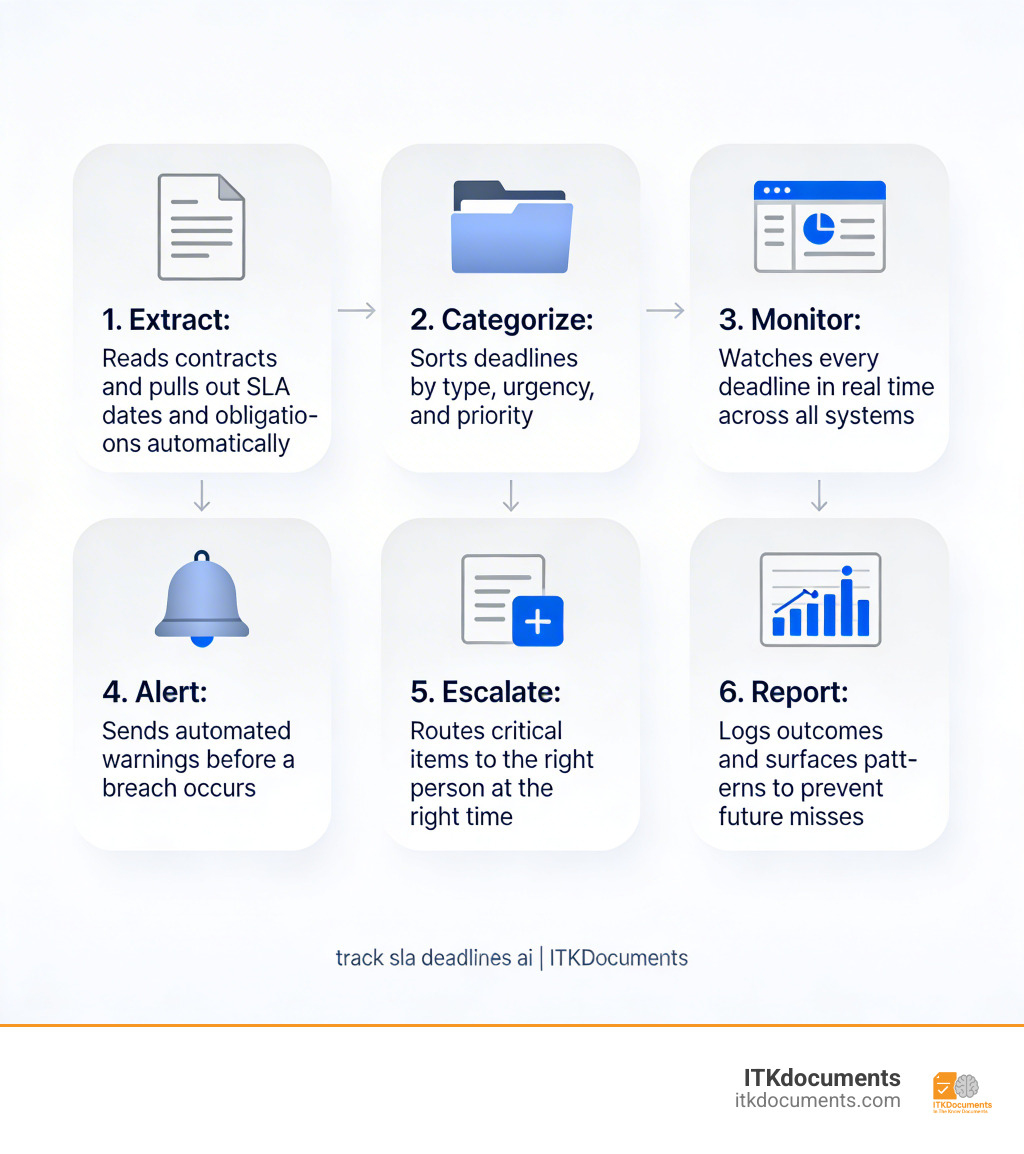
Track SLA deadlines AI is the fastest, most reliable way to stay on top of contractual obligations — here's how it works at a glance:
| Step | What AI Does |
|---|---|
| 1. Extract | Reads contracts and pulls out SLA dates and obligations automatically |
| 2. Categorize | Sorts deadlines by type, urgency, and priority |
| 3. Monitor | Watches every deadline in real time across all systems |
| 4. Alert | Sends automated warnings before a breach occurs |
| 5. Escalate | Routes critical items to the right person at the right time |
| 6. Report | Logs outcomes and surfaces patterns to prevent future misses |
Missing an SLA deadline isn't just an inconvenience. The consequences are concrete and costly.
Think about what happens when a license renewal slips through the cracks — a $50,000+ project halts. Or a compliance filing missed by hours triggers a six-figure penalty. These aren't rare edge cases. For contract managers and compliance officers handling large document portfolios, they're an everyday risk.
The core problem is simple: SLAs live inside documents, and documents don't send reminders.
Most teams still rely on manual calendars, spreadsheets, and memory to track dozens — sometimes hundreds — of deadlines across contracts, vendor agreements, and regulatory obligations. That approach doesn't scale. And when volume grows, something eventually gets missed.
AI changes that equation entirely. Instead of chasing deadlines, you let a system extract them, monitor them, and alert you before anything goes wrong.
I'm Mike O'Brien, founder and CEO of ITKDocuments and former Chief Procurement Officer at Aviva, where I managed multibillion-dollar contract portfolios and saw how organizations lose value when they can't track SLA deadlines with AI or any reliable system. That direct experience with the real cost of missed obligations is what drives everything we build at ITKDocuments.
Let's walk through exactly how to set this up.
The Evolution of SLA Management: From Manual to AI-Powered
In the "old days" (which for many teams is still today), Service Level Agreement (SLA) management was a reactive sport. You'd sign a contract, someone would hopefully highlight the key dates, and then those dates would be buried in a spreadsheet that only one person knew how to navigate.
This manual approach is a recipe for disaster. Human error is inevitable when you're dealing with hundreds of pages of legalese. Administrative overhead eats up 25-35% of a team's time just trying to keep the tracker updated. When a process change occurs—like a new internal approval step—it can cause delays of up to four days just to get a simple task published or completed.
The shift to AI-powered tracking represents a move from "reactive reporting" to "proactive assurance." According to Forrester insights on the shift to proactive service management, the future of management is about preventing issues before they impact the user.
One of the biggest myths about AI is that it's here to replace us. In reality, Gartner research on AI augmenting service teams shows that only 20% of customer service leaders have reduced staffing due to AI. Instead, AI is being used to amplify capabilities.
By using AI to track sla deadlines ai, organizations gain:
- Real-time visibility: You always know exactly how much time is left on every commitment.
- Scalability: You can handle 10x the contract volume without hiring 10x the staff.
- Proactive alerts: No more "Oh no, that was due yesterday" moments.
How to Track SLA Deadlines AI: A Step-by-Step Guide
If you're ready to stop firefighting and start automating, the transition is smoother than you might think. Most teams can see productivity gains within the first month.
Step 1: Data Ingestion and Natural Language Processing
The first hurdle is getting the data out of the "paper prison." AI uses Natural Language Processing (NLP) to read your PDFs and Word documents just like a human would—but much faster.
When we Extract SLA data, the AI doesn't just look for dates; it understands the context.
Step 2: Automated Categorization and Priority Assignment
Once the obligations are extracted, the AI categorizes them by type, urgency, and complexity, automatically assigning priority levels based on business impact.
Step 3: Multi-channel Integration and Workflow Sync
Your deadlines shouldn't live in a vacuum. The system must sync with your existing tools—CRM, email, or project management boards.
Setting Up Your System to Track SLA Deadlines AI
Configure your "SLA Registry" as your central source of truth:
- Define Your Custom Parameters
- Set Target Times and Warning Thresholds
- Map Your Data Sources: Ensure your SLA Dashboard is pulling from all relevant cloud integrations.
Key Features to Track SLA Deadlines AI Effectively
- Real-time Monitoring
- Intelligent Task Reprioritization
- Escalation Matrices
- Audit Trails
- Historical Analytics: Use Reporting to identify bottlenecks.
Why Legal and Operations Teams Benefit Most from AI Automation
| Feature | Manual Tracking | AI-Driven Tracking |
|---|---|---|
| Response Times | Slow, dependent on manual triage | 40-60% improvement via auto-routing |
| Visibility | Siloed in spreadsheets | Real-time Dashboard |
| Risk Mitigation | Reactive | Proactive alerts before breach |
| Admin Overhead | High (25%+ of staff time) | Low (automated) |
| Scalability | Requires more headcount | Handles increased volume with existing staff |
Automating Escalations and Risk Mitigation
- Tier 1 (Warning): At 75% time elapsed, assignee gets a nudge.
- Tier 2 (Risk): At 90%, task is reprioritized.
- Tier 3 (Critical): At 98%, department head notified.
- Tier 4 (Breach): AI logs event and prepares financial impact report.
Frequently Asked Questions about AI SLA Tracking
How long does it take to implement AI for SLA tracking?
Most users achieve a 5-minute setup. Full organizational rollout typically takes 4 to 6 weeks.
Can AI handle multi-channel and cross-system SLA monitoring?
Yes. AI unifies SLAs across email, chat, voice, and your CRM, ensuring consistent tracking across all platforms.
What is the typical ROI for AI-driven SLA management software?
- Efficiency: 25-40% improvement in operational efficiency within the first year.
- Cost Savings: Eliminating late fees and capturing early payment discounts.
- Headcount Stability: Handle higher volumes without additional staff.
Conclusion
By choosing to track sla deadlines ai, you're building a "prevention engine" for your business.
At ITKdocuments, we make this transition effortless. Start your AI-powered SLA tracking today with a free trial and see how much time your team can win back.