 Mike O'Brien
Why Your Contracts Are Costing You More Than You Think

Why Your Contracts Are Costing You More Than You Think
A contract analytics platform is software that uses AI to automatically read, extract, and analyze data from legal contracts — so your team can find risks, track obligations, and spot missed value without manual review.
Here's what these platforms typically do:
- Extract key clauses, dates, and obligations from contracts automatically
- Flag risks, deviations, and missing provisions
- Track SLAs, renewals, and compliance deadlines
- Turn unstructured contract text into searchable, structured data
- Provide dashboards and alerts for your entire contract portfolio
Think about this: organizations lose 9.2% of annual revenue every year from poor contract management. And 57% of business development leaders say contracting inefficiencies are actively slowing their revenue growth.
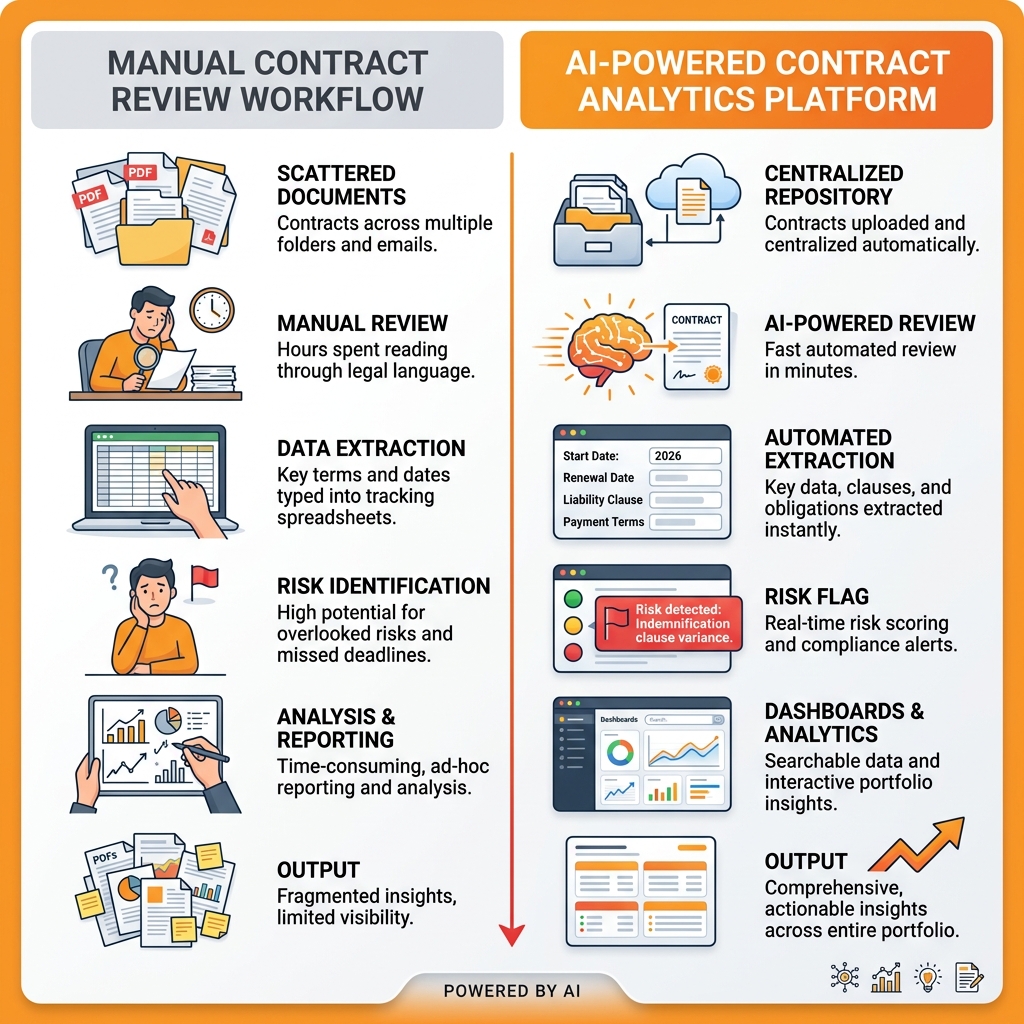
The reason is simple. Most teams are still reviewing contracts manually — hunting through PDFs, tracking deadlines in spreadsheets, and relying on memory to catch risky clauses. It's slow, error-prone, and expensive.
Every missed renewal, buried obligation, or overlooked liability clause is a cost your business didn't have to pay.
Contract analytics platforms were built to solve exactly this problem — replacing hours of manual document review with AI that works in minutes.
I'm Mike O'Brien, founder and CEO of ITKDocuments and former Chief Procurement Officer at Aviva, where I personally managed multibillion-dollar contract portfolios and saw how difficult it is to extract real insight from contracts at scale. That experience is what drives everything we build around the contract analytics platform at ITKDocuments. In the sections below, we'll break down exactly how these platforms work, what to look for, and how to choose the right one for your team.
What is a Contract Analytics Platform?
At its simplest, a contract analytics platform is the "brain" for your legal documents. While a standard repository just stores files, an analytics platform understands what is written inside them. It transforms unstructured content—those long, dense paragraphs of legalese—into structured data that your business can actually use.
The magic happens through a combination of several advanced technologies:
- Natural Language Processing (NLP): This allows the software to "read" and understand the context of human language. It doesn't just look for keywords; it understands that a "Limitation of Liability" clause is still a limitation of liability even if the word "limit" isn't explicitly used in the header.
- Machine Learning (ML): These platforms are trained on millions of existing contracts. They learn patterns over time, becoming increasingly accurate at identifying specific provisions, scoring risks, and suggesting changes.
- Generative AI: Modern platforms in 2026 use Generative AI to summarize complex agreements into plain English and even draft responses or redlines based on your company's specific playbooks.
- OCR Technology: Optical Character Recognition is the foundation. It allows the platform to process "dead" documents—like scanned PDFs or legacy paper contracts—and turn them into searchable digital text.
The accuracy of these systems has reached a tipping point. In recent benchmarks, AI achieved a 94% accuracy rate on NDA risk identification, while experienced lawyers averaged around 85%. This isn't about replacing humans; it's about giving them a superpower that catches the things they might miss at 4:00 PM on a Friday.

How AI Powers the Contract Analytics Platform
The transition from a manual process to an automated one starts with pattern recognition. When you upload a document, the AI performs automated indexing, identifying the parties, the effective date, and the governing law.
One of the most critical steps in this process is extracting metadata. Metadata includes the "who, what, and when" of the contract. By pulling this data into a structured format, the platform allows you to run reports across your entire portfolio instantly. Instead of opening 500 files to see which ones have a "Change of Control" clause, you simply filter your dashboard.
For organizations with thousands of old files sitting in SharePoint or Google Drive, legacy contract migration is often the biggest hurdle. A robust contract analytics platform uses AI to bulk-process these files, translating them if necessary (many platforms now support dozens of languages) and organizing them into a central, searchable "source of truth." This moves your team from reactive searching to data-driven decisions.
Core Capabilities of Modern Analytics Tools
What does an advanced contract analytics platform actually do on a day-to-day basis? It acts as a 24/7 auditor for your agreements.
- Extracting Obligations: We often say that a contract is a "promise in writing." But those promises are easily forgotten. Modern tools excel at extracting obligations, identifying exactly who owes what to whom and by when.
- Risk Scoring and Deviation Analysis: The platform compares a new contract against your "gold standard" or legal playbook. It flags deviations—like an unusually high indemnity cap—and assigns a risk score so you know which agreements need the most attention.
- SLA Tracking and Dashboards: For procurement and service-based businesses, SLA tracking is vital. The platform monitors performance metrics and displays them on an SLA dashboard, ensuring you never pay for services you didn't receive.
- Compliance Monitoring: Whether it's GDPR, CCPA, or industry-specific regulations like SOX, the AI scans for mandatory provisions and alerts you if any are missing.
- Renewal Alerts and Audit Trails: Manual tracking leads to "auto-renewal traps." Analytics platforms provide proactive alerts months before a deadline. Furthermore, they maintain a full audit trail of every version and change, which is essential for regulatory exams.
The ROI of Automating Contract Analysis
If you're wondering if a contract analytics platform is worth the investment, the numbers speak for themselves. The "cost of doing nothing" is often much higher than the subscription fee of the software.
- Revenue Recovery: Research from World Commerce & Contracting shows that organizations lose an average of 9.2% of their annual revenue due to poor contract management. This "value leakage" comes from missed rebates, unimplemented price increases, and untracked commitments.
- Efficiency Savings: In M&A due diligence—a historically grueling manual task—Deloitte found that AI-powered analysis can lead to 75% efficiency savings. What used to take a team of lawyers weeks can now be completed in days or even hours.
- Time is Money: Legal teams spend an average of 20 to 30 minutes per agreement on routine data extraction. For an enterprise with 1,000 contracts a year, that's 500 hours of high-priced attorney time wasted on clerical work.
- Negotiation Leverage: 90% of CEOs believe their companies leave money on the table during negotiations because they lack visibility into their historical data. A contract analytics platform gives you that data instantly, showing you exactly what you've agreed to with similar vendors in the past.
Choosing a Contract Analytics Platform for Your Business
Not all platforms are created equal. When evaluating your options, the first question is usually: do you need a standalone analytics tool or a full Contract Lifecycle Management (CLM) platform?
Standalone tools focus specifically on post-signature analysis and data extraction. They are often faster to implement. Full CLM platforms handle everything from the first draft to the final signature, with analytics built in.
| Feature | Standalone Analytics | Full CLM Platform |
|---|---|---|
| Setup Time | Days to Weeks | Months |
| Primary Goal | Data Extraction & Insights | Workflow & Document Creation |
| Best For | Audits, M&A, Legacy Review | End-to-End Process Control |
| Integration | High (plugs into existing storage) | High (replaces existing workflows) |
Regardless of the type, you must ensure the platform offers advanced reporting capabilities. You should be able to create custom charts and exports without needing a degree in data science. Security is also non-negotiable; look for SOC 2 Type II compliance and 256-bit encryption to protect your sensitive legal data.
Selecting a Contract Analytics Platform for SMBs vs. Enterprises
Your organization's size will dictate your priorities.
For SMBs: You likely don't have a massive IT department to manage a six-month rollout. You need "out-of-the-box" value and a simple search functionality that works from day one. SMBs should look for platforms with flat-rate pricing to avoid "per-document anxiety" that can kill user adoption.
For Enterprises: Scale is the name of the game. You need portfolio-wide intelligence that can handle 10,000+ documents across different regions and business units. High-level features like API access for connecting to your ERP (like SAP or Oracle) and CRM (like Salesforce) are essential for keeping data consistent across the company. Role-based permissions are also vital to ensure that while Sales can see their contract statuses, they can't access sensitive HR agreements.
Future Trends: Agentic AI and Generative Insights
As we move through 2026, the contract analytics platform is evolving from a passive tool into an active "agent." This is the era of Agentic AI.
Instead of you having to look for risks, the AI agent proactively monitors your repository and "acts" on your behalf. For example, if a new regulation is passed, the AI can automatically identify every affected contract, draft an amendment, and queue it for legal review.
We are also seeing the rise of self-serve intelligence. In the past, if a Sales Rep wanted to know the termination notice period for a client, they had to email the Legal team. Today, they can simply chat with contracts using natural language. They ask, "What is the notice period for the Acme Corp agreement?" and the AI provides the answer instantly, cited directly from the document.
Predictive analytics is another frontier. By analyzing thousands of past negotiations, the AI can predict which clauses are likely to be "redlined" by a specific counterparty, allowing you to start with a more acceptable version and close deals faster.
Frequently Asked Questions about Contract Analytics
What is the difference between CLM and contract analytics?
Think of CLM (Contract Lifecycle Management) as the entire journey of a contract—from the first "Hello" to the final "Goodbye." It handles drafting, approvals, and e-signatures. Contract analytics is the intelligence layer. It can exist inside a CLM or as a standalone tool. Its job is to read the documents and tell you what they mean, regardless of where they are stored.
How accurate is AI-powered contract data extraction?
Modern platforms are incredibly accurate, often hitting the 95% to 99% range for standard clauses (like dates, parties, and governing law). However, for highly complex or "non-standard" language, we always recommend a "human-in-the-loop" approach. The best platforms will flag "low-confidence" extractions for a human to double-check.
How do these platforms integrate with existing CRM and ERP systems?
Most leading platforms offer pre-built connectors for tools like Salesforce, HubSpot, and Microsoft Dynamics. This allows your sales team to see contract data directly inside their CRM. For Finance and Procurement, ERP integrations ensure that the pricing found in a contract matches the invoices being paid in the system.
Conclusion
The days of manual contract review are numbered. In an era where speed and data-driven precision are the primary competitive advantages, a contract analytics platform is no longer a luxury—it's a necessity.
At ITKDocuments, we've built our platform to eliminate the "implementation dread" that usually comes with legaltech. We offer a 5-minute setup to value, meaning you can go from "I have a pile of PDFs" to "I have a searchable, risk-scored dashboard" in the time it takes to grab a coffee.
With our instant AI risk assessments, cloud integrations, and a commitment to transparency, we help you stop just storing your contracts and start using them as the strategic assets they are.
Ready to see the hidden insights in your portfolio? Start your contract transformation with a free trial today.