 Mike O'Brien
The Hidden Cost of Getting Contract Risk Assessment Wrong

The Hidden Cost of Getting Contract Risk Assessment Wrong
Contract risk assessment is the process of identifying, evaluating, and prioritizing the risks embedded in a contract before — and after — it is signed. Here is a quick summary of what it covers:
- What it is: A structured process to spot financial, legal, operational, and compliance risks in contract terms
- Why it matters: Research shows an average of 9.2% of annual revenue is lost due to contract mismanagement
- When to do it: At every stage — drafting, negotiation, pre-signature, and post-signature
- Who it's for: Legal, procurement, compliance, and operations teams managing contract portfolios
- How it works: Review contract terms against a risk framework, score each risk by likelihood and impact, then act on the results
Every contract your organization signs is meant to reduce uncertainty. The paradox is that contracts themselves introduce risk — through vague language, one-sided clauses, missed obligations, and terms that quietly erode value over time.
Most teams only discover this after something goes wrong. A deadline is missed. A liability clause triggers an unexpected payout. An auto-renewal locks the business into an unwanted commitment for another year.
The problem is not that people are careless. It is that manual contract review was never designed to catch everything — especially at scale. As contract volumes grow, the gaps grow with them.
That is where a structured approach to contract risk assessment changes the game. It moves your organization from reactive to proactive — catching problems before they become expensive.
I'm Mike O'Brien, founder of ITKDocuments and former Chief Procurement Officer at Aviva, where I managed multibillion-dollar contract portfolios and saw how unmanaged contract risk quietly drains organizational value. That experience sits at the core of how I think about contract risk assessment and what it takes to get it right at scale.
What is Contract Risk Assessment and Why is it Essential?
At its heart, contract risk assessment is the systematic process of looking at a legal agreement and asking, "What could go wrong here, and how much will it cost us if it does?" It is not just about checking if the names are spelled correctly; it is about quantifying the potential for loss or harmful outcomes arising from the terms of the deal.
Why is this so essential? Because the stakes are incredibly high. research shows that an average of 9.2% of annual revenue is lost due to contract mismanagement. For a company with £10 million in revenue, that is nearly a million pounds vanishing into thin air every year due to missed renewals, uncaptured rebates, or poor supplier performance.
In the public sector, the numbers are even more staggering. The UK government spends roughly £49 billion annually on third-party contracts. When hidden contract risks aren't managed, public funds are wasted. In fact, detected public sector fraud rose from £310m in 2019/20 to £525m in 2020/21, highlighting the desperate need for better partner assessment and oversight.
Without a formal assessment process, you are essentially playing "Legal Roulette." You might win a few rounds, but eventually, the house (the risk) wins. A thorough assessment protects your organization's:
- Financial exposure: Preventing unexpected costs and ensuring price certainty.
- Legal liability: Shielding the business from lawsuits and unenforceable terms.
- Operational continuity: Ensuring that if a vendor fails, your business doesn't stop.
The Difference Between Review and Analysis
We often hear people use "contract review" and "contract risk analysis" interchangeably, but they are different beasts.
A standard contract review is a baseline check. It asks: Is this contract accurate? Is it complete? Does it reflect what we discussed? It's a "yes/no" exercise.
Contract risk analysis, however, is about impact. It asks: If this vendor misses a delivery by 48 hours, what is the ripple effect on our production line? If this data privacy clause is breached, what is our maximum financial exposure under current regulations?
Analysis involves strategic decision-making. It requires you to weigh the "risk appetite" of your organization against the potential rewards of the deal. It turns a static document into a dynamic piece of business intelligence.
When to Conduct an Assessment
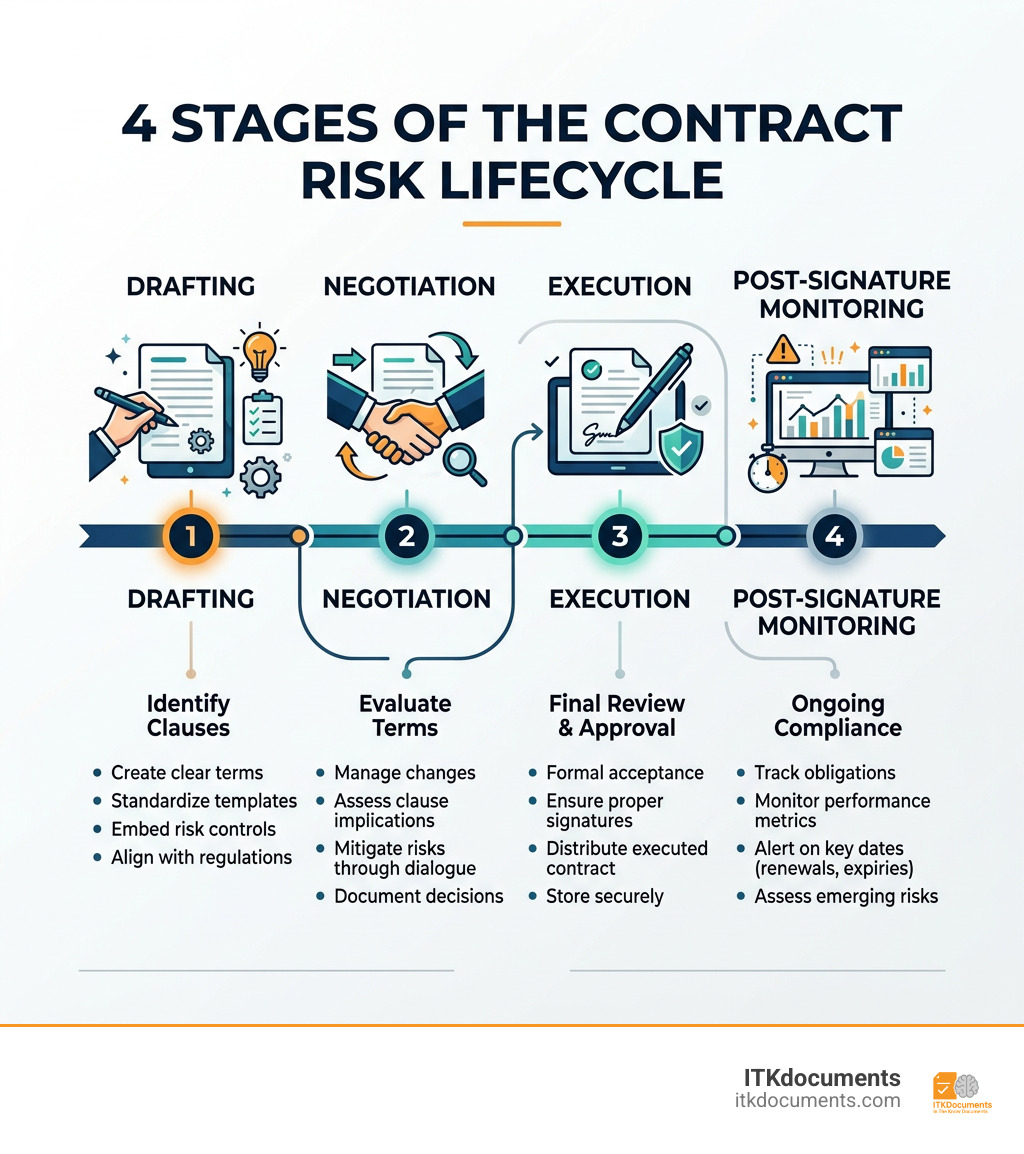
If you only assess risk right before you sign, you've already missed several opportunities to protect yourself. Effective contract risk assessment should happen throughout the lifecycle:
- Drafting Phase: Setting the "gold standard" using templates that already include your preferred risk-mitigation language.
- Negotiation: Identifying where the counterparty is pushing back and what that means for your risk profile.
- Pre-signature: The final "triage" where you decide if the remaining risks are acceptable.
- Post-signature Monitoring: Ensuring the obligations you signed up for are actually being met.
- Renewal Cycles: Re-evaluating the risk. Has the vendor's financial stability changed? Have new laws made old clauses risky?
The 5 Main Types of Contractual Risk
To manage risk, we first have to name it. We generally categorize contract risks into five main buckets:
- Financial Risk: This includes budget overruns, hidden fees, or the risk of a counterparty going bankrupt.
- Legal Risk: This often stems from unenforceable contract clauses that trigger disputes or leave you without a leg to stand on in court.
- Operational Risk: The danger that a contract failure will stop you from doing business (e.g., a software outage or a supply chain break).
- Reputational Risk: If your partner engages in unethical behavior or suffers a massive data breach, your brand gets dragged through the mud too.
- Regulatory Compliance: The risk of fines or lost licenses because a contract doesn't meet standards like GDPR, HIPAA, or the Public Contracts Regulations 2015.
Managing these starts with extracting obligations so you actually know what everyone is supposed to be doing.
Identifying High-Impact Provisions in Contract Risk Assessment
Some clauses carry more weight than others. When we perform a contract risk assessment, we pay extra attention to these "heavy hitters":
- Liability Caps: Is the vendor's liability limited to the "fees paid in the last 12 months"? If the deal is worth £10k but their mistake causes £1m in damage, you have a problem.
- Termination for Convenience: Can they walk away with 30 days' notice? What does that do to your operations?
- Automatic Renewals: The "silent killer" of budgets. Without alerts, you might be stuck in a contract you no longer need.
- Indemnification and Performance Terms: These determine who pays when a third party sues. indemnification and performance terms are often the most complex parts of a review.
- Force Majeure: After 2020, everyone realized how important these "Act of God" clauses are. Do they include pandemics?
- Confidentiality: Essential for protecting your IP and trade secrets.
To keep track of these, many organizations are now extracting SLAs (Service Level Agreements) into digital dashboards so they can see performance in real-time.
Quantifying Risk with a Scoring Matrix
You can't manage what you can't measure. A risk matrix helps you move from "this feels risky" to "this is a Level 15 Critical Risk." You calculate a Risk Score by multiplying Consequence (how bad is it?) by Likelihood (how likely is it to happen?).
| Consequence Rating | Financial Impact | Description |
|---|---|---|
| 5 - Catastrophic | >$1,000,000 | Business-ending or massive legal/reputational hit |
| 4 - Critical | $500k - $1M | Significant impact on annual goals |
| 3 - Significant | $100k - $500k | Serious disruption requiring senior management intervention |
| 2 - Disruptive | $25k - $100k | Managed through standard internal procedures |
| 1 - Minor | <$25,000 | Negligible impact |
Likelihood Ratings:
- Rare: 0-10% chance
- Unlikely: 10-40% chance
- Possible: 40-60% chance
- Likely: 60-90% chance
- Almost Certain: 90-100% chance
The Rule of Thumb: If any single risk score is 5 or above (e.g., a "Critical" consequence with a "Rare" likelihood), the contract should probably be flagged for formal legal review.
How to Build a Proactive Risk Management Framework
Building a framework means moving away from "heroic efforts" (where one person stays up all night reading 200 pages) toward a scalable system.
- Inventory Management: You can't assess what you can't find. Centralize your contracts in one place.
- Standardized Templates: Use pre-approved language for 80% of your deals to reduce the "surface area" for risk.
- Clause Libraries: Maintain a "playbook" of fallback clauses. If a vendor won't accept your "Indemnity A," do you have an "Indemnity B" ready?
A big part of this framework involves extracting metadata like expiration dates, governing law, and party names so you can search and filter your entire portfolio in seconds.
Operationalizing Your Contract Risk Assessment with AI
This is where the magic happens. In the past, a thorough contract risk assessment for a complex agreement could take 8 hours. With AI, it takes about 5 minutes.
Modern AI tools use Natural Language Processing (NLP) to "read" contracts just like a lawyer would, but much faster. They can:
- Flag non-standard language: Instantly tell you if a liability clause deviates from your company policy.
- Spot missing protections: Alert you if a contract is missing a mandatory Data Processing Agreement (DPA).
- Pattern analysis: Identify if one specific vendor across your portfolio consistently misses their SLA targets.
Research shows that organizations using automated assessment report a 70% reduction in time to identify risks and a detection accuracy of 95%+. By using an SLA dashboard, you can see these risks visualized across your entire business.
Steps for Conducting a Thorough Assessment
If you're ready to start, follow these five steps:
- Identify Obligations: What are we actually promising to do, and what are they promising us? Don't forget the "grey areas."
- Evaluate Counterparty Stability: Check their credit, their reputation, and their previous performance. Are they a fraud risk?
- Score Risks: Use the matrix we discussed above to give the contract a quantitative score.
- Implement Mitigation: Negotiate caps, add insurance requirements, or create a backup plan (e.g., a secondary supplier).
- Continuous Monitoring: A contract is a living document. Check in quarterly to see if the risk profile has changed.
For a deeper dive, you can refer to this [PDF] Contract Risk Assessment and Mitigation Strategies for a sample checklist.
Best Practices for Ongoing Monitoring and Mitigation
The work doesn't end at signature. To keep risks low, you need a "set it and forget it" system for monitoring.
- Centralized Repository: Stop keeping contracts in email inboxes or local hard drives.
- Automated Alerts: Set reminders for 90, 60, and 30 days before a renewal or an obligation deadline.
- Audit Trails: Keep a record of who changed what and why. This is vital for compliance and dispute resolution.
- Risk Transfer: Use insurance and indemnification clauses to push the risk onto the party best equipped to handle it.
Effective reporting allows you to show leadership exactly how much risk you've mitigated. Using a dashboard gives you a bird's-eye view of your entire contract landscape, so you can spot "clusters" of risk before they explode.
Frequently Asked Questions about Contract Risk
How does contract risk assessment differ from standard contract review?
Standard review checks for accuracy and completeness, while risk assessment evaluates the potential financial, legal, and operational impact of specific terms on the business. It's the difference between checking if a car has all its wheels (review) and calculating the likelihood of a crash based on the driver and the road conditions (risk assessment).
When should a contract require formal legal review based on risk scoring?
Organizations typically mandate legal review when a risk score exceeds a specific threshold (e.g., a score of 5 or higher on a 1-25 scale) or when financial impact exceeds $100,000. Many of our users set "auto-triage" rules: if the AI detects an unlimited liability clause or a contract value over a certain amount, it is automatically routed to the Legal department.
What are the most common "hidden" risks in vendor agreements?
Hidden risks often include vague "indemnity" language that could be interpreted too broadly, "auto-renewal" clauses without notice periods that trap you in unwanted service, and "limitation of liability" caps that are disproportionately low compared to potential damages. Another common one is "Governing Law" — if you're in London but the contract is governed by the laws of Singapore, a dispute could become very expensive very quickly.
Conclusion
The "old way" of managing contracts — spreadsheets, manual redlining, and hoping for the best — is no longer enough. In an era where a single missed clause can lead to a 9.2% revenue loss, contract risk assessment is a strategic necessity, not a luxury.
At ITKdocuments, we built our platform to take the "grunt work" out of this process. Our AI-powered engine allows you to extract obligations, track SLAs, and flag risks instantly. We offer a 5-minute setup to value, meaning you can move from a pile of PDFs to a searchable, risk-scored dashboard faster than you can finish your morning coffee.
Don't let your contracts be a black hole of hidden liabilities. Turn them into a strategic advantage by taking control of your risk profile today.