 Mike O'Brien
Why Obligation Risk Flagging AI Is Now a Compliance Essential

Why Obligation Risk Flagging AI Is Now a Compliance Essential
Obligation risk flagging AI is technology that automatically scans contracts and documents to identify risky clauses, missed deadlines, and compliance gaps — before they become costly problems.
Quick answer for compliance and contract teams:
| What it does | Why it matters |
|---|---|
| Scans contracts using AI and NLP | Finds risks humans miss or catch too late |
| Flags non-compliant clauses automatically | Reduces regulatory exposure |
| Monitors obligations in real time | Prevents SLA breaches and value leakage |
| Prioritizes high-risk items | Saves hours of manual review |
| Generates audit-ready reports | Supports regulators and stakeholders |
If you manage contracts at scale, you already know the problem. Obligations are buried in dense legal language. Deadlines slip. Risky clauses go unnoticed until a deal falls apart or a regulator comes knocking. The stakes keep rising too — by 2025, 72% of S&P 500 companies disclosed at least one material AI-related risk in their annual filings, up from just 12% in 2023. The volume, complexity, and speed of modern contract portfolios have simply outgrown what manual review can handle.
That's exactly the gap obligation risk flagging AI was built to close.
I'm Mike O'Brien, founder and CEO of ITKDocuments and former Chief Procurement Officer at Aviva, where I managed multibillion-dollar contract portfolios and saw how organizations struggle to extract actionable insight from their documents — the same challenge that drives my focus on obligation risk flagging AI today. In this guide, I'll walk you through how this technology works, what risks it catches, and how to put it to work in your organization.
Understanding Obligation Risk Flagging AI and Its Evolution
At its core, obligation risk flagging AI isn't just a fancy search tool; it is a socio-technical system. This means it combines advanced mathematics with human-centric design to solve real-world legal and operational headaches.
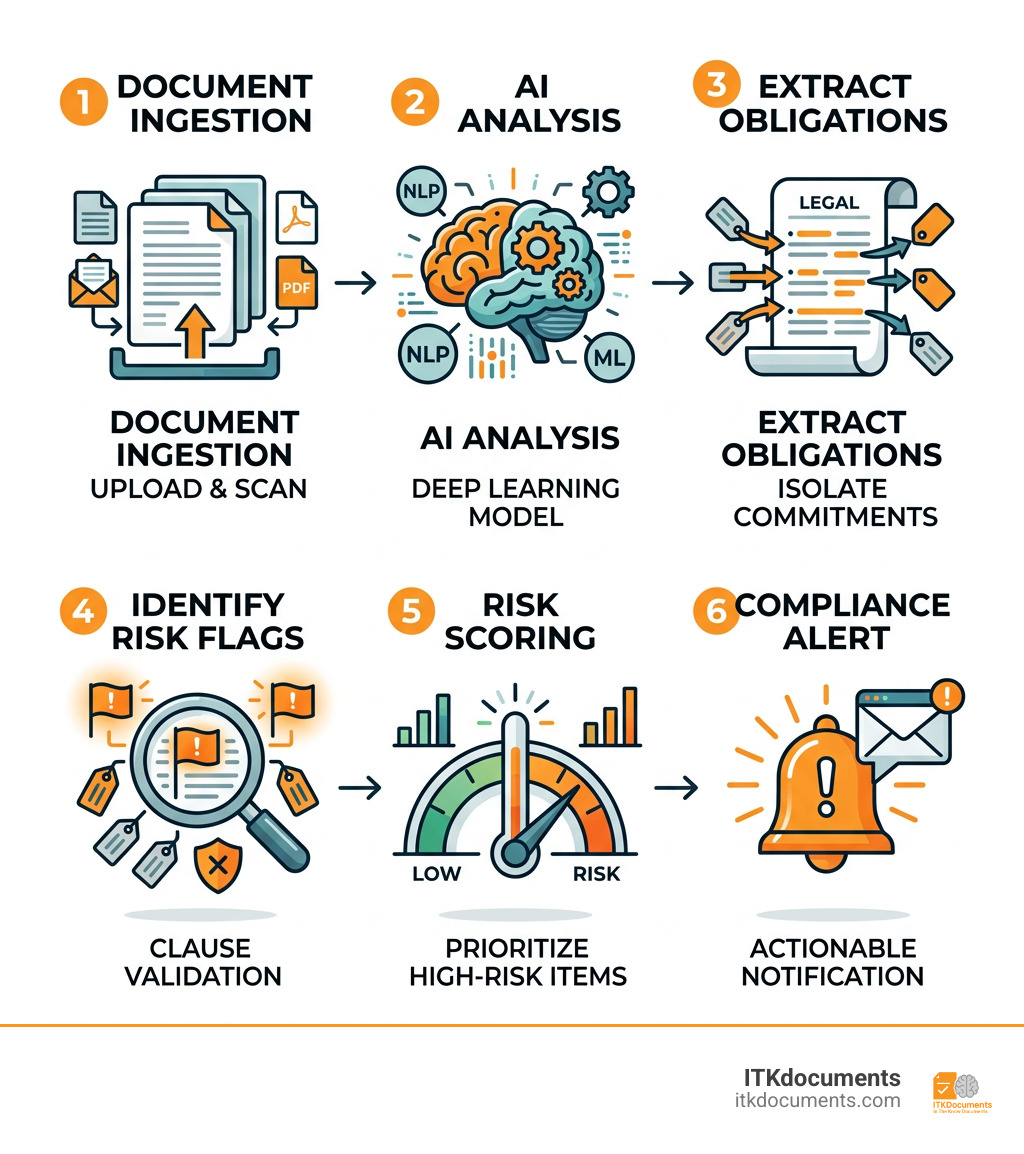
Modern systems rely heavily on Machine learning (ML), where algorithms analyze thousands of historical legal documents to learn what a "standard" obligation looks like versus one that carries high risk. By using Extract Obligations features, we can now pull specific commitments out of a 100-page PDF in seconds.
The "magic" happens through pattern recognition. The AI doesn't just look for keywords like "termination"; it understands the context around the word. It recognizes when a termination clause is one-sided or lacks a cure period, which is a classic red flag.
How Obligation Risk Flagging AI Differs from Traditional Systems
In the "old days" (which for some is still last Tuesday), we relied on static rules and manual monitoring. You'd set up an Excel sheet and hope someone remembered to check the "Expiry Date" column.
Traditional systems are reactive. They tell you when something has already gone wrong. In contrast, modern AI uses Natural language processing (NLP) to provide real-time signals. It can Extract Metadata across your entire portfolio to show you aggregate risks you didn't even know you had.
While manual review is slow, prone to "Friday afternoon fatigue," and impossible to scale, AI-driven flagging is proactive. It looks at the intent of the language, not just the presence of specific words.
The Role of Predictive Analytics in Modern Risk Detection
One of the most exciting shifts we've seen is the move toward Predictive analytics. Instead of just flagging what is in the document today, AI can use historical data to forecast which obligations are most likely to be breached.
By identifying anomalies—such as a vendor whose contract language has shifted significantly over three renewals—the AI assigns a risk score. This allows your team to focus their limited time on the 5% of contracts that represent 90% of your potential liability.
Critical Risks Identified by AI in Lending and M&A
In high-stakes environments like M&A and commercial lending, the "unknown unknowns" are what keep dealmakers awake at night. Legal risk is often cited as a top dealbreaker.

During M&A due diligence, we use AI to hunt for Hidden Contract Risks like:
- Change-of-Control Triggers: Clauses that allow a vendor to terminate or hike prices if your company is acquired.
- Uncapped Liabilities: Legal "landmines" that could expose the buyer to infinite financial loss.
- Indemnity Clauses: Overly broad requirements to pay for the other party's legal mistakes.
Identifying Legal and Regulatory Risks with Obligation Risk Flagging AI
The regulatory landscape is moving faster than most legal teams can track. Between the EU AI Act, GDPR, and the FCPA, the cost of a "miss" is astronomical.
Obligation risk flagging AI can automatically scan for non-compliant language that violates these specific acts. For example, it can check if your data processing agreements meet the latest General Data Protection Regulation standards.
Furthermore, for public companies, the SEC is watching closely. Form 10-K AI risk disclosures are now a standard requirement. If your AI isn't helping you Extract SLA data to prove you are meeting your public commitments, you are leaving yourself open to "AI-washing" penalties.
Reputational and Cybersecurity Risks in the S&P 500
It's not just about the fine; it's about the brand. Reputational risk was the most cited AI concern among S&P 500 firms in 2025, with 38% of firms flagging it.
Cybersecurity is the other side of that coin. With the 2023 cyber disclosure rules, companies must disclose material incidents within four days. AI helps by flagging "cyber-obligations" in vendor contracts—such as a requirement for the vendor to notify you within 24 hours of a breach.
To stay ahead, many firms are now using AI red teaming to find weaknesses in their own automated systems before a bad actor does.
The Measurable Benefits of AI-Powered Risk Detection
Why bother with all this tech? Because the numbers don't lie. When we move from manual "staring and comparing" to an automated system, the ROI is immediate.
| Feature | Manual Review | AI-Powered Flagging |
|---|---|---|
| Speed | Weeks for a large portfolio | Minutes |
| Accuracy | ~60-70% (human error) | 95%+ with human-in-the-loop |
| Cost | High (Lawyer/Analyst hours) | Low (SaaS subscription) |
| Scalability | Linear (need more people) | Exponential (handles millions of pages) |
By using a centralized Dashboard and automated Reporting, teams can see their total risk posture at a glance. Organizations have reported up to a 98% reduction in false positive alerts when they switch from "dumb" keyword rules to intelligent AI flagging.
Improving Speed and Accuracy in Financial Services
In financial services, speed is a competitive advantage. AI-driven Network analysis allows institutions to see how a risk in one contract might cascade through a whole web of related entities.
By using an SLA Dashboard, banks can prioritize alerts based on actual financial impact. Instead of an analyst looking at 1,000 "medium" alerts, they get a prioritized list of the 5 "critical" ones that could lead to a regulatory fine or a major service outage.
Overcoming Myths and Limitations in AI Risk Management
There is a lot of "hype" out there, but we need to be honest about what AI can and cannot do. One of the biggest myths is the "Black Box"—the idea that AI makes decisions and we can't understand why.
Modern obligation risk flagging AI is designed for explainability. If the system flags a clause as "High Risk," it should point you directly to the sentence in the contract and explain why it made that call. This is part of the Ethical use of AI. We shouldn't just trust the machine; we should audit it.
You can read more about these common misconceptions on our Blog.
Why Human Oversight Remains Essential
AI is a co-pilot, not the captain. Expert judgment is still required for nuanced interpretation. A classic example is the Moffatt v. Air Canada(2024) case, where a company was held liable for a chatbot's incorrect advice.
The takeaway? You cannot outsource your accountability to an algorithm. Strategic decision-making requires a "human-in-the-loop" to ensure that the AI's findings align with the company's specific risk appetite and the broader business context.
The Future of Obligation Risk Management: Agentic and Generative AI
We are entering the era of "Agentic AI." While traditional AI flags a problem, Agentic AI can actually do something about it.
71% of organizations reported regular use of generative AI in early 2025. In risk, this means AI that doesn't just say "This clause is bad," but actually drafts a suggested amendment that is compliant with your company's playbook.
As Gartner Shifting decision rights suggests, we are moving toward a world where AI agents will augment or automate half of all business decisions. This allows for continuous monitoring—a system that never sleeps and is always checking your obligations against the latest market signals.
Advanced Workflows and Agentic AI Systems
Future systems will integrate with the NIS2 Directive and other frameworks to provide automated remediation. If a new law is passed in Europe, an agentic system could theoretically scan your entire portfolio, identify affected contracts, and draft notice letters to all vendors—all before your coffee gets cold.
This proactive portfolio steering is the "Holy Grail" of contract management. It turns a legal department from a "cost center" into a strategic "risk mitigation engine."
Best Practices for Implementing AI Risk Flagging Programs
Ready to dive in? Don't try to boil the ocean. Start with a clear plan.
- Integrate with existing workflows: Whether you use a Virtual Data Room (VDR) or a standard cloud drive, the AI should come to you, not the other way around.
- Focus on specific regulations: Are you worried about Colorado Compliance and enforcement or the Texas Compliance and enforcement? Set your AI to look for those specific triggers first.
- Data Curation is King: AI is only as good as the data you feed it. Ensure your contracts are OCR-ready and organized.
- Cross-functional collaboration: Compliance, Legal, and IT need to be in the same room (or Slack channel) when setting up these systems.
Steps to Get Started with AI-Powered Detection
- Inventory Assessment: Figure out where your contracts live. Are they in SharePoint, Box, or a dusty filing cabinet?
- Pilot Programs: Start with one high-risk area, like Health Insurance Portability and Accountability Act compliance or GDPR.
- Vendor Due Diligence: Ensure the AI vendor you choose respects data privacy.
- Feedback Loops: When the AI makes a mistake (and it will), tell it. Most modern systems learn from your corrections, getting smarter every day.
Frequently Asked Questions about Obligation Risk Flagging AI
Can AI replace legal professionals in risk detection?
No. AI is designed to handle the "grunt work"—scanning thousands of pages for specific clauses. This frees up legal professionals to do what they do best: provide strategic advice, negotiate complex deals, and apply human judgment to nuanced risks.
How does AI handle "black box" explainability for regulators?
Modern obligation risk flagging AI uses "Attribution." When the AI flags a risk, it provides a direct link to the source text and a plain-English explanation of why it was flagged. This creates an audit trail that regulators love because it shows a defensible, repeatable process.
What are the primary differences between generative AI and traditional ML for risk flagging?
Traditional ML is great at "classification" (e.g., "Is this an indemnity clause? Yes/No"). Generative AI is better at "synthesis" (e.g., "Summarize the risks in this clause and draft a safer version"). Most top-tier systems now use a combination of both to provide the most comprehensive protection.
Conclusion
At ITKdocuments, we believe that staying compliant shouldn't be a full-time manual chore. Our platform uses obligation risk flagging AI to help you extract obligations, track SLAs, and identify hidden risks in seconds.
With a 5-minute setup to value, seamless cloud integrations, and instant AI risk assessments, we help you move from reactive "firefighting" to proactive compliance management. Don't let your obligations become liabilities.
Ready to see how it works for your own contracts? Get started with a free trial today.