 Mike O'Brien
Why Risk Assessment in Contracts Is Essential for Every Business

Why Risk Assessment in Contracts Is Essential for Every Business
Risk assessment in contracts is the process of identifying, evaluating, and managing potential threats hidden inside contractual agreements — before they turn into costly disputes, missed obligations, or compliance failures.
Here is a quick summary of what it involves:
| Step | What It Means |
|---|---|
| Identify | Find clauses that could create liability, ambiguity, or obligation gaps |
| Assess | Rate each risk by likelihood and potential impact |
| Mitigate | Renegotiate terms, add protective clauses, or set alerts |
| Monitor | Track obligations, SLAs, and renewals throughout the contract lifecycle |
| Report | Document findings and maintain an audit-ready record |
Contracts touch every part of a business — from procurement and sales to finance and operations. Yet most organizations still rely on manual reviews that are slow, inconsistent, and easy to miss. A single overlooked clause — an automatic renewal, an uncapped liability, or an ambiguous delivery term — can quietly escalate into a significant financial or legal problem.
The stakes are real. And the volume of contracts most organizations manage makes thorough manual review nearly everyone's nightmare at scale.
I'm Mike O'Brien, founder of ITKDocuments and former Chief Procurement Officer at Aviva, and Head of Procurement at BP where I managed multibillion-dollar contract portfolios and saw how missed risks in contracts lead to value leakage and operational disruption. That lived experience shapes everything I know about risk assessment in contracts — and it's why I built a platform to make it faster and more reliable.
Defining Contract Risk Management and Its Business Impact
When we talk about contract risk management, we are describing the systematic process of keeping your business safe from its own paperwork. At its core, it is about visibility. You cannot manage what you cannot see, and most contract risks are experts at playing hide-and-seek in the fine print.
The impact of failing to perform a proper risk assessment in contracts ripples across the entire organization:
- Financial Loss: This isn't just about lawsuits. It's about missed price adjustments, uncollected rebates, or paying for services you no longer use because of an automatic renewal.
- Operational Efficiency: When obligations are unclear, projects stall. We've seen teams argue for weeks over who was responsible for a specific deliverable simply because the Statement of Work (SOW) was vague.
- Liability Exposure: Without a clear understanding of indemnification and limitation of liability clauses, one mistake by a vendor could result in a catastrophic financial hit to your bottom line.
- Reputational Damage: Failing to meet a high-profile client's SLA doesn't just cost money; it costs trust. In the age of social media and instant reviews, a breach of contract is a public relations nightmare waiting to happen.
By treating contract risk as a strategic priority rather than a "legal-only" problem, we empower every department—from sales to procurement—to move faster with confidence.
The Standard Process for Risk Assessment in Contracts
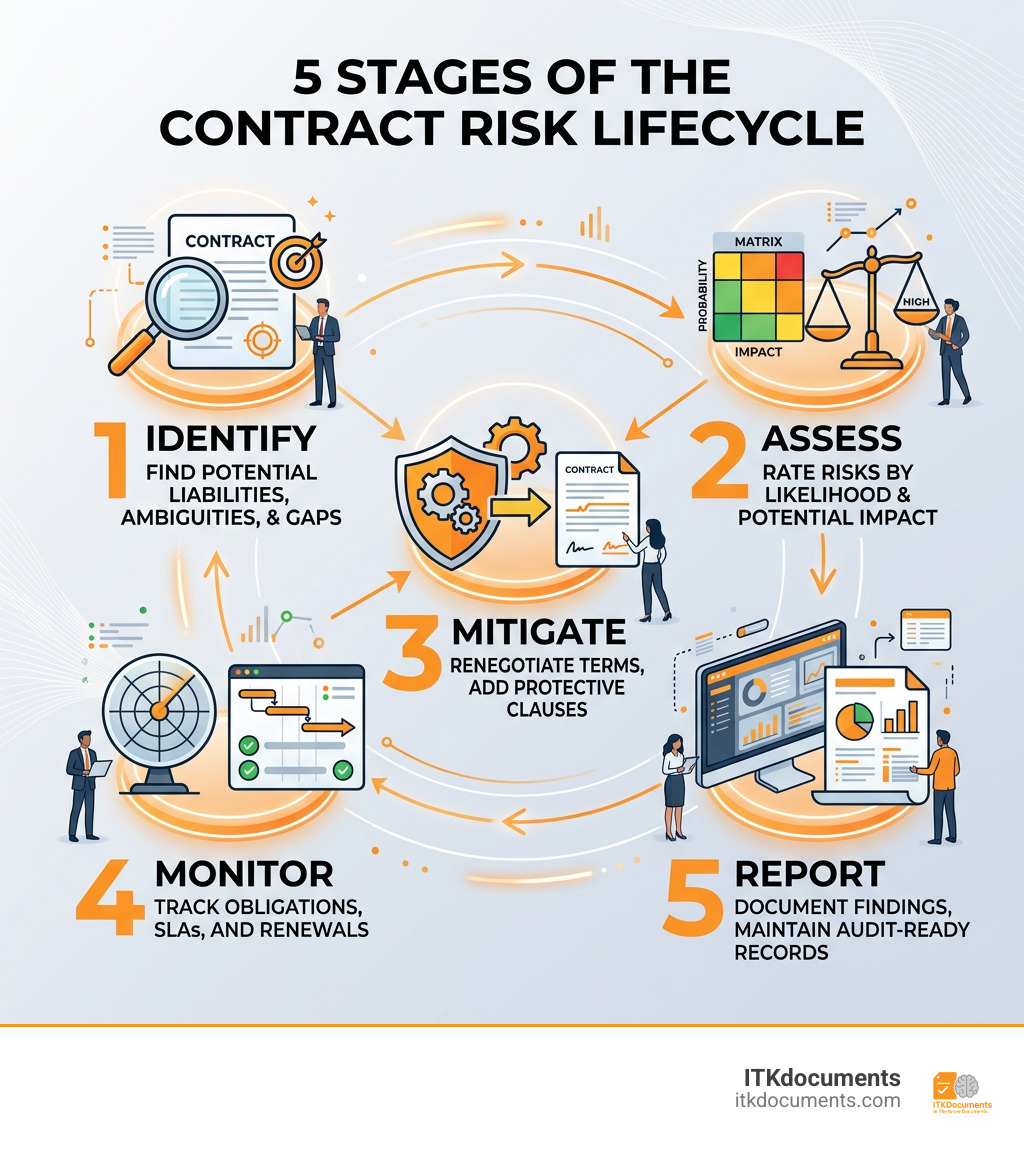
Effective risk assessment isn't a one-time event; it's a lifecycle. Think of it like a health check-up for your business relationships. To do it right, we follow a structured five-step approach.

- Identification: This is the "search" phase. We comb through the document to find every obligation, right, and penalty. We look for hidden contract risks like "most favored nation" clauses or restrictive non-competes.
- Assessment: Once identified, we weigh the risk. What is the likelihood of this event happening? If it does happen, what is the "damage score"? A 10% chance of a $1 million fine is often a higher priority than a 90% chance of a $1,000 delay.
- Mitigation: This is where we take action. We might extract obligations to ensure the operations team knows exactly what they need to deliver, or we might go back to the negotiating table to cap our liability.
- Monitoring: Contracts are living documents. We must track performance against the agreed terms. Are the SLAs being met? Is the vendor's insurance still valid?
- Reporting: Finally, we need a paper trail. Stakeholders need to see the risk profile of the entire contract portfolio to make informed executive decisions.
Identifying the 5 Main Types of Contractual Risks
To perform a thorough risk assessment in contracts, you need to know what you're looking for. Most risks fall into one of these five buckets.
Liability and Legal Risks
These are the "big ones" that keep legal teams up at night. They involve the legal consequences of non-performance or accidents.
- Indemnification: Who pays if a third party sues? If this clause is one-sided, you could be on the hook for the other party's mistakes.
- Force Majeure: Recent global events have shown how critical these "Act of God" clauses are. If a supply chain collapses, does the contract allow for delays, or are you in default?
- Dispute Resolution: If things go south, where do you settle it? Fighting a court case in a foreign jurisdiction is significantly more expensive than local arbitration.
- Regulatory Compliance: Every contract must comply with industry-specific laws like GDPR, HIPAA, or financial regulations. Failure to do so can lead to "noncompliance" fines that dwarf the value of the contract itself.
Operational and Financial Risks
These risks affect the day-to-day health of your business and your bank account.
- Performance Issues: What happens if the service is just "okay" but not great? Without clear SLA data, you have no leverage to demand better service.
- Missed Revenue: In sales contracts, risks often look like "revenue leakage"—untracked price increases or volume discounts that were never applied.
- Hidden Costs: Does the contract mention "reasonable expenses" without a cap? Those "small" costs can add up to a 20% budget overrun.
- Supply Chain Interdependencies: If your vendor relies on a single sub-contractor who fails, your entire project might fail. We need to assess the "contractor risk factors" like their financial stability and past performance.
How AI and Scoring Improve Detection Accuracy
The old way of doing things—printing out a 60-page contract and attacking it with a yellow highlighter—is dead. It's too slow, and humans are notoriously bad at spotting what isn't there (like a missing termination clause).
Research shows that organizations using automated assessment report a 70% reduction in time to identify risks. Even better, they report higher detection accuracy across large portfolios. When you use AI, you aren't just faster; you're smarter.
| Feature | Manual Redlining | AI-Powered Detection |
|---|---|---|
| Speed | Hours or days | Seconds |
| Consistency | Varies by reviewer | 100% consistent |
| Missing Clause Detection | Very difficult | Instant |
| Negotiation Leverage | Based on memory | Based on data-driven benchmarks |
| Portfolio Visibility | Non-existent | Real-time dashboard |
How AI Automates Risk Assessment in Contracts
AI doesn't just "read" text; it understands legal concepts. It can perform clause extraction to pull out every indemnity or termination provision across 1,000 documents at once. It uses anomaly detection to flag terms that deviate from your company's "gold standard" or playbook.
Perhaps most importantly, it creates an audit trail. Every time a risk is flagged or a change is suggested, it's recorded. This is essential for regulatory compliance and internal audits.
The Role of Contract Risk Scoring in Prioritization
Not all risks are created equal. Contract risk scoring assigns a quantitative value (usually on a 0-100 scale) to a contract based on its contents.
- A "0" might be a standard NDA with no deviations.
- A "90" might be a vendor contract with unlimited liability and no clear termination rights.
By setting risk thresholds, you can automate your workflow. For example, any contract with a score over 70 could be automatically routed to the General Counsel, while low-score contracts are fast-tracked for signature. This allows your legal team to focus on the "needles in the haystack" rather than getting bogged down in routine paperwork.
A Practical Checklist for Evaluating Agreements
Whether you are using AI or doing a manual spot-check, you need a framework. A risk assessment in contracts checklist ensures that no department's needs are forgotten.
Key Elements of a Risk Assessment in Contracts Checklist
- Obligations: Can we actually do what this says? Are the requirements specific or "gray"?
- Schedules: Are the deadlines realistic? What are the penalties for a one-day delay versus a one-week delay?
- Location-Specific Risks: Does this contract involve data transfer from the EU? Are there local tax implications or exchange rate risks?
- Governing Law: If we have to sue, are we doing it in our backyard or halfway across the world?
- Termination Clauses: How do we get out? Is there a "termination for convenience" or are we locked in for five years?
- Counterparty Due Diligence: Who are we signing with? Do they have a history of defaults or lawsuits?
- Auto-Renewals: Does the contract renew automatically? If so, what is the notice period to cancel? (This is one of the most common ways businesses lose money).
Best Practices for Global Risk Mitigation
Managing risk across a global portfolio requires more than just a good checklist; it requires a culture of compliance.
- Standardization: Use templates and clause libraries. When everyone starts from the same approved base, the risk of "rogue" clauses drops significantly.
- Interdisciplinary Collaboration: Risk isn't just a legal problem. Procurement knows about supply chain risks; Finance knows about credit risks; Sales knows about competitive risks. Use a centralized platform so everyone can see the same data.
- Ongoing Training: Laws change. A clause that was safe last year might be noncompliant this year. Regular training ensures your team knows what "red flags" to look for.
- Automated Reporting: Don't wait for a crisis to check your risk levels. Use automated reporting to get a weekly summary of upcoming renewals, expiring certificates of insurance, and unfulfilled obligations.
Frequently Asked Questions about Contract Risk
What are the most common hidden risks in contracts?
The most common "gotchas" are automatic renewals, "most favored nation" pricing clauses that you can't actually track, and vague "indemnity" language that covers things it shouldn't. Another huge one is hidden obligations—requirements buried in an exhibit or an external URL that your operations team never sees.
How often should organizations perform a contract audit?
For high-value or high-risk vendors, a quarterly review is best practice. For the general portfolio, an annual audit is usually sufficient. However, any major "trigger event"—like a change in data protection regulations or a merger—should prompt an immediate reassessment.
Can AI replace legal counsel in risk assessment?
No, and it shouldn't. AI is a "force multiplier." It does the heavy lifting of finding the risks, but a human expert is still needed to decide on the best mitigation strategy. Think of AI as the high-powered microscope that finds the bacteria; the lawyer is the doctor who decides on the treatment.
Conclusion
In today's business world, a manual approach to risk assessment in contracts is no longer sustainable. It's too slow, too prone to error, and it leaves too much money on the table.
At ITKdocuments, we believe that contract data should be a strategic asset, not a hidden liability. Our AI-powered platform offers a 5-minute setup to value, allowing you to instantly flag risks, extract obligations, and query your contracts with the ease of a Google search.
Don't let your next big risk stay hidden in the fine print. Start your free trial with ITKdocuments today and gain the clarity you need to grow your business with confidence.