 Mike O'Brien
Why AI-Driven Risk Assessment Is Changing How Organizations Manage Risk

AI-driven risk assessment uses machine learning, predictive analytics, and natural language processing to identify, monitor, and prioritize risks automatically — faster and more accurately than manual methods.
Quick answer: What is AI-driven risk assessment?
| Feature | What it means for you |
|---|---|
| Automated detection | Flags risks in contracts, data, and operations without manual review |
| Predictive analytics | Anticipates problems before they occur, not after |
| Real-time monitoring | Continuous oversight instead of periodic spot checks |
| Broader coverage | Analyzes 100% of data, not just a sample |
| Faster response | Up to 40% quicker reaction to critical risk exposures |
For contract managers and compliance officers, the stakes are high. Missed obligations, SLA breaches, and overlooked risk clauses don't just cause headaches — they cause real financial and reputational damage. Traditional methods rely on manual reviews that are slow, inconsistent, and simply can't keep up with the volume of documents modern organizations handle.
AI changes that equation entirely. Research shows AI tools can analyze contract data 360 times faster than manual methods — and expand audit coverage by up to 50% without adding headcount.
This guide walks you through everything you need to know: the real benefits, the honest challenges, and how to implement AI risk assessment in a way that actually works.
I'm Mike O'Brien, founder and CEO of ITKDocuments, with over two decades leading procurement and operations at organizations like bp and Aviva — where managing complex contract portfolios and AI-driven risk assessment is something I've seen transform (and when mismanaged, damage) organizations firsthand. That experience is the foundation for everything we build at ITKDocuments.
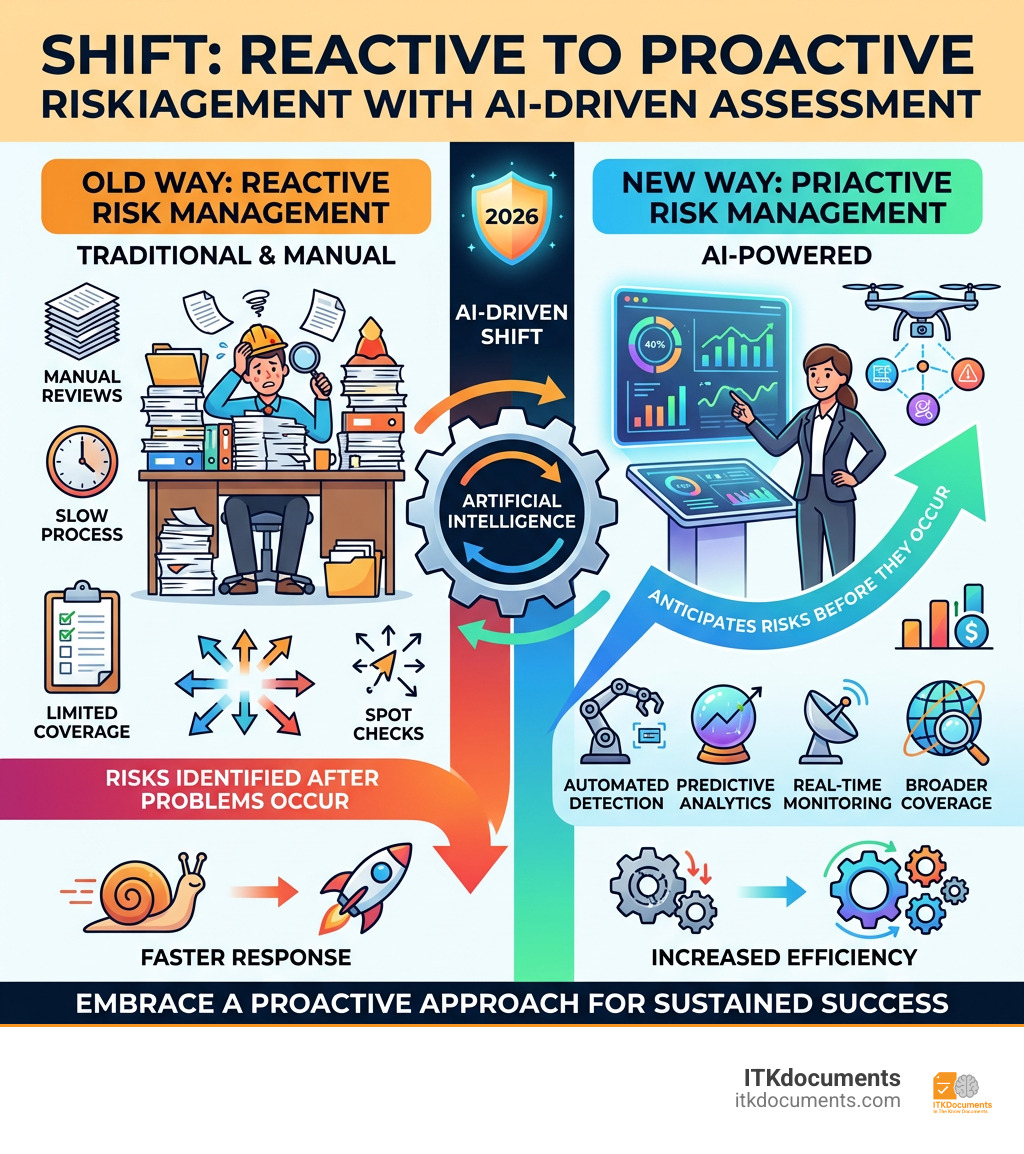
AI vs. Traditional Risk Assessment: A Paradigm Shift
In the old days (which for many of us, was just last Tuesday), risk assessment was a grueling exercise in sampling. You'd take 5% of your contracts, hand them to a team of tired auditors, and hope they didn't miss the one "landmine" clause hidden in the other 95%.
AI-driven risk assessment fundamentally changes this by moving from a sampling model to a "census" model. It looks at everything, all the time. By using quantitative AI risk modeling, organizations can now assign mathematical values to threats that used to be purely "gut feelings."
| Category | Traditional Assessment | AI-Driven Assessment |
|---|---|---|
| Data Volume | Limited samples | 100% of available data |
| Processing Speed | Weeks or months | Minutes or hours |
| Human Bias | High (subjective judgment) | Low (data-backed logic) |
| Monitoring | Periodic (annual/quarterly) | Continuous (real-time) |
| Perspective | Reactive (historical focus) | Proactive (predictive focus) |
How AI-driven risk assessment transforms internal audit
Internal audit used to be the department that told you why you went bankrupt six months after it happened. With AI, it becomes a preventive powerhouse. We've seen that AI-driven tools can expand audit scope by up to 50% without requiring a single new hire.
By automating the "grunt work"—the data extraction and pattern matching—auditors can focus on high-value strategy. For example, instead of just finding a missing signature, AI can help in identifying hidden contract risks like unfavorable indemnity clauses or auto-renewal traps that drain budgets. It's about moving from "What happened?" to "What might happen, and how do we stop it?"
Real-time forecasting and nuanced perspectives
Traditional risk models are often "flat." They look at a contract in a vacuum. Modern AI, however, brings in a wider, more nuanced perspective. It can synthesize diverse data sources—market fluctuations, weather patterns affecting supply chains, and even communication signals—to provide a holistic view of danger.
If a hurricane is brewing in the Atlantic, an AI system doesn't just track the storm; it identifies which of your vendors are in the path, flags their obligations, and alerts you to potential delivery failures before the first raindrop falls.
Strategic Benefits and Real-World Impact
The numbers behind AI-driven risk assessment aren't just marketing fluff; they are transformative for the bottom line. Integrating predictive analytics into audit processes can reduce risk-related incidents by up to 30%. Furthermore, continuous auditing practices supported by AI result in a 40% quicker response to critical risk exposures.
Success stories in finance and technology
Major players are already proving the ROI of these systems. In the banking sector, the COIN system (Contract Intelligence) has been a revelation, saving an estimated 360,000 hours of manual legal review every single year. Imagine what your team could do with an extra 360,000 hours. You might finally finish that "organizational cleanup" project everyone's been avoiding.
In the tech world, Google used DeepMind AI to predict data center stresses. By anticipating when cooling systems needed to work harder, they reduced cooling energy consumption by 40%, significantly lowering the risk of outages. When your risk assessment tool also saves you millions in electricity, that's a win-win.
Enhancing safety and reliability in projects
In project management, especially in high-stakes industries like construction and healthcare, AI is literally a lifesaver. Autodesk's AI implementation helped reduce safety incidents by 40% and project delays by 25%. By analyzing historical data and real-time signals, the AI flags indicators of delay or danger that a human project manager might overlook.
This is particularly useful when you need to extract obligations from thousands of pages of project documentation to ensure every safety standard is met.
Frameworks and Implementation Challenges
You can't just "buy an AI" and call it a day. You need a structure. Several frameworks have emerged to help organizations manage this transition responsibly.
- NIST AI RMF: The NIST AI Risk Management Framework is the gold standard. It's built on four functions: Govern, Map, Measure, and Manage. It helps you build a culture where AI risk is treated with the same gravity as financial risk.
- FAIR™ Methodology: This focuses on quantifying risk in financial terms. By looking at "Loss Magnitude" and "Loss Event Frequency," it helps leaders make data-driven decisions on where to spend their security budget.
Overcoming data quality hurdles in AI-driven risk assessment
The biggest enemy of a good AI is bad data. "Garbage in, garbage out" is an old saying, but in AI, it's more like "Garbage in, catastrophe out." Organizations must invest in data cleansing to ensure their models aren't learning from biased or incomplete information.
Privacy is another hurdle. With regulations like GDPR, you can't just feed your AI every piece of data you own. You must ensure that the AI respects data sovereignty and that you aren't inadvertently creating "model poisoning" risks where adversarial data corrupts your assessment logic.
Addressing the black box and skill gaps
One of the scariest parts of AI for many executives is the "Black Box" problem—the idea that the AI makes a decision, but no one knows why. This is why Explainable AI (XAI) is so critical. Your risk tool should be able to show its work, explaining the reasoning behind a "High Risk" flag.
There is also a significant skill gap. Auditors and risk managers need to become "AI literate." Organizations like The IIA and ISACA are now offering specialized training to help professionals bridge the gap between traditional methodology and machine learning capabilities.
Best Practices for Successful AI Driven Risk Assessment
Success with AI requires a "Human-in-the-Loop" approach. AI shouldn't be the judge and jury; it should be the world's most efficient research assistant.
- Start with focused use cases: Don't try to automate your entire risk department overnight. Start with something specific, like SLA dashboards or contract risk flagging.
- Establish clear evaluation criteria: How do you know it's working? Measure time saved, the number of "near-misses" identified, and the reduction in manual errors.
- Collaborate across functions: Risk isn't just a legal problem. It's an IT problem, a finance problem, and an operations problem. Get everyone in the room.
Step-by-step strategy for organizational adoption
If you're ready to start your journey with AI-driven risk assessment, follow this roadmap:
- Data Preparation: Consolidate your documents. If your contracts are scattered across five different cloud drives and a physical filing cabinet, your AI won't be able to help you.
- Pilot Testing: Choose one high-impact project. Run the AI alongside your manual process and compare the results.
- Specialized Prompting: Learn how to talk to the AI. Developing a library of effective prompts for risk identification is key to getting accurate results.
- Continuous Improvement: AI models need to be "retrained" as new risks emerge. A model trained in 2019 wouldn't have known what a "global pandemic clause" looked like; today, it's a standard requirement.
Establishing governance and ethical oversight
To keep your AI on the straight and narrow, consider an internal AI Ethics Committee. They should oversee "Red Teaming" (where you intentionally try to trick the AI to find its weaknesses) and review "Model Cards"—documentation that explains what a model is designed to do and, more importantly, what it shouldn't do.
The Future Outlook: NLP, Blockchain, and Predictive Analytics
The future of AI-driven risk assessment is incredibly bright (and a little bit sci-fi). We are moving toward "Frontier Models" that can understand context better than some junior associates.
- NLP Advancements: Natural Language Processing is becoming so sophisticated that AI can detect "sentiment" in a contract—identifying if a clause is written in a way that is intentionally vague or overly aggressive.
- Blockchain Integration: Combining AI with blockchain could create "Smart Contracts" that automatically trigger risk alerts or financial penalties the moment an SLA is breached.
- Real-time Risk Alerts: Imagine a world where your phone pings you because a change in a vendor's credit rating just elevated your project's risk profile from "Green" to "Yellow."
The role of advanced risk modeling
We are seeing a shift toward more quantitative AI risk modeling. Instead of just saying a risk is "High," future systems will calculate a score (1-64) based on:
- Likelihood: How often is this expected to happen?
- Severity: How much will it cost if it does?
- Observability: How quickly can we detect it?
This level of granular detail allows for autonomous systems that can mitigate minor risks without human intervention, leaving the big, complex decisions to us.
Frequently Asked Questions about AI Risk Assessment
How accurate is AI for risk assessment?
When fed high-quality data, AI is significantly more accurate than humans for pattern detection and anomaly identification. It doesn't get tired at 4:00 PM on a Friday and it doesn't skim over "boring" paragraphs. However, it still requires human oversight to provide context—AI can find a discrepancy, but a human understands if that discrepancy actually matters.
Can AI replace human judgment in auditing?
No. AI is a tool to augment judgment, not replace it. Think of it like a high-powered telescope. The telescope shows you the stars, but the astronomer interprets what they mean. The most successful organizations use a "human-in-the-loop" approach where AI does the heavy lifting of data analysis and humans make the final strategic calls.
What are the primary ethical considerations for AI risk tools?
Bias and transparency are the big ones. If your training data is biased, your risk assessments will be too. There's also the "accountability" factor—if an AI misses a risk, who is responsible? This is why governance frameworks and clear human oversight are non-negotiable.
Conclusion
The transition to AI-driven risk assessment isn't just a technological upgrade; it's a competitive necessity. When data moves at the speed of light, relying on manual, reactive risk management is like bringing a paper map to a GPS fight.
At ITKDocuments, we've built our platform to make this transition seamless. With a 5-minute setup to value and instant AI risk assessments, we help you turn your contract pile into a strategic asset. By automating the extraction of obligations and monitoring SLAs, we empower you to move from fighting fires to preventing them.
The reward for embracing AI is clear: better decisions, lower costs, and the peace of mind that comes from knowing you've looked at every single detail. Ready to see what you've been missing? Learn more about our AI risk assessment services and start your free trial today.