 Mike O'Brien
Contract Risk Assessment Tool: The Complete Guide to AI-Powered Risk Management

Understanding the Role of a contract risk assessment tool
When we talk about a contract risk assessment tool, we aren't just talking about a digital filing cabinet. We are talking about a proactive shield for your business. In the traditional sense, assessing risk meant a legal professional sitting down with a highlighter and a pot of coffee, manually scanning hundreds of pages to find "gotcha" clauses. Today, that process is being revolutionized by AI. This shift is essential because the volume of modern business agreements has outpaced the capacity of even the most diligent legal teams.
Risk in contracts generally falls into four buckets:
- Financial Exposure: This goes beyond simple price tags. It includes hidden costs, uncapped liabilities, price escalation clauses that aren't tied to inflation, or unfavorable payment terms that bleed revenue over time.
- Legal Liability: Indemnity clauses that shift too much responsibility onto your shoulders, weak dispute resolution terms, or governing law clauses that force you into expensive out-of-state litigation.
- Operational Risk: Vague delivery timelines, lack of clear service level agreements (SLAs), or "auto-rollover" clauses that lock you into services you no longer need without a clear exit strategy.
- Compliance Standards: Failure to meet regional data protection laws (like GDPR or CCPA) or industry-specific regulatory requirements like HIPAA in healthcare or SOC2 in technology services.
Modern tools use a 5-step risk assessment process to keep these threats at bay. First, they identify the potential risks within the text using pattern recognition. Second, they classify who might be harmed, whether it's the finance department, the end-user, or the company's reputation. Third, they evaluate the severity using a risk matrix that weighs probability against impact. Fourth, they implement findings by comparing them against a company "playbook" to see if the risk is acceptable. Finally, they review and update the assessment as the business environment or legal landscape changes.
Essential Features for Modern Risk Management
Not all tools are created equal. If you are shopping for a contract risk assessment tool, you need to look beyond basic keyword searching. You need a system that understands context and intent. According to Gartner, modern contract management must focus on the entire lifecycle, and risk assessment is the foundation of that cycle.
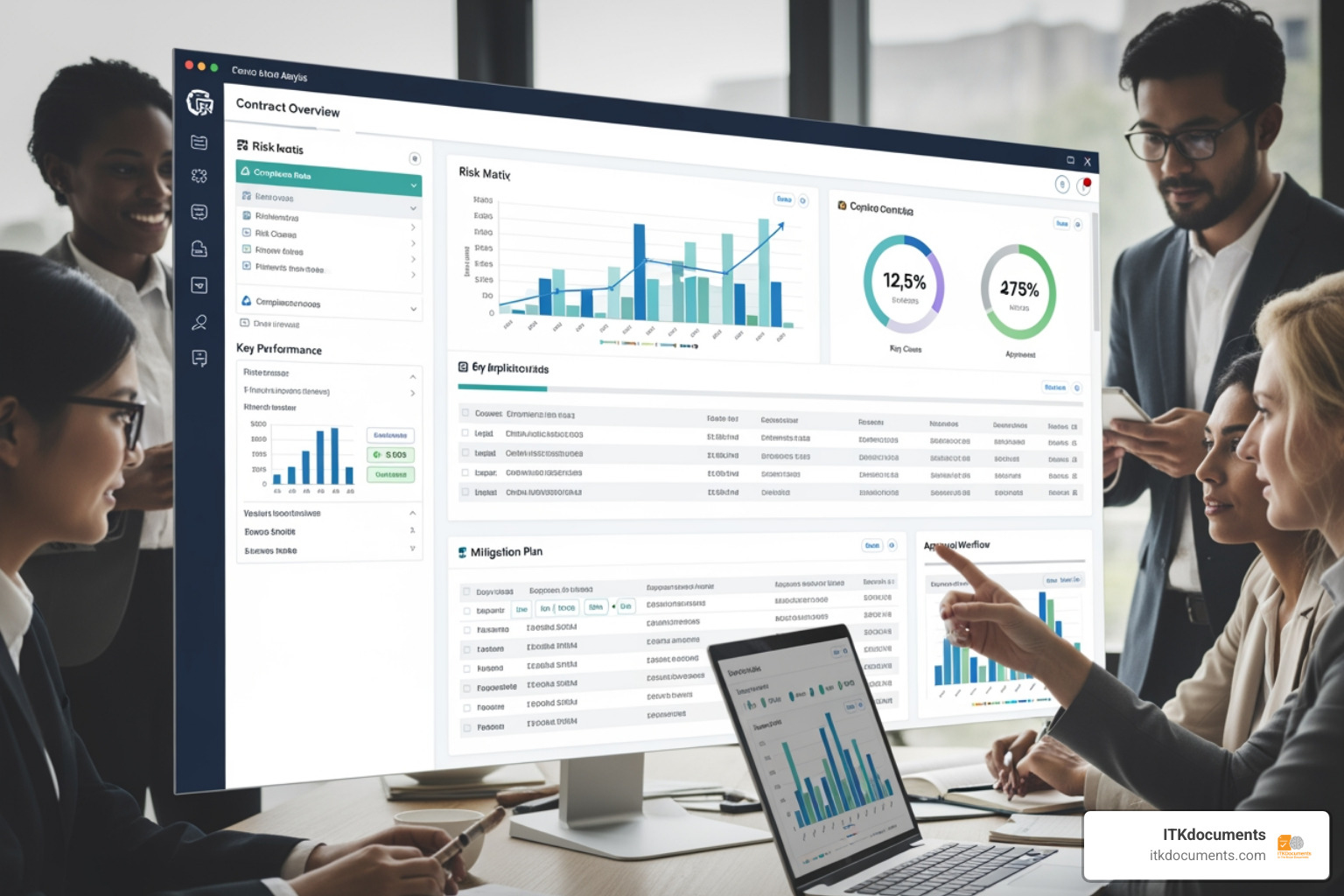
One of the most critical features is clause extraction. This allows the software to pull out specific sections—like limitation of liability or termination rights—and analyze them in isolation. When combined with a risk matrix, the tool can assign a numerical score to a contract based on the probability of an issue occurring and the severity of its impact. This turns subjective legal opinions into objective, actionable data.
A high-quality tool should also offer:
- Playbook Integration: This is your "gold standard." The AI compares the incoming contract against your company’s pre-approved "house style" and flags anything that deviates. It ensures that every negotiator, regardless of experience, adheres to the same safety standards.
- Clause Libraries: A repository of "safe" alternative language that can be swapped in to mitigate a flagged risk instantly. This reduces the back-and-forth during negotiations.
- Risk Scoring: Visual dashboards that use "traffic light" systems (red, yellow, green) to show you at a glance which contracts need immediate attention and which can be fast-tracked.
- Mitigation Recommendations: It’s one thing to find a problem; it’s another to solve it. Leading tools suggest specific actions—like adding a specific indemnity cap—to lower the risk profile of a document.
We often see businesses blindsided by Hidden Contract Risks like indemnity carve-outs or missing jurisdictional clauses. By using advanced Reporting features, management can see trends across the entire portfolio, identifying which vendors consistently present the highest risk and adjusting procurement strategies accordingly.
AI vs. Manual: Improving Efficiency and Accuracy
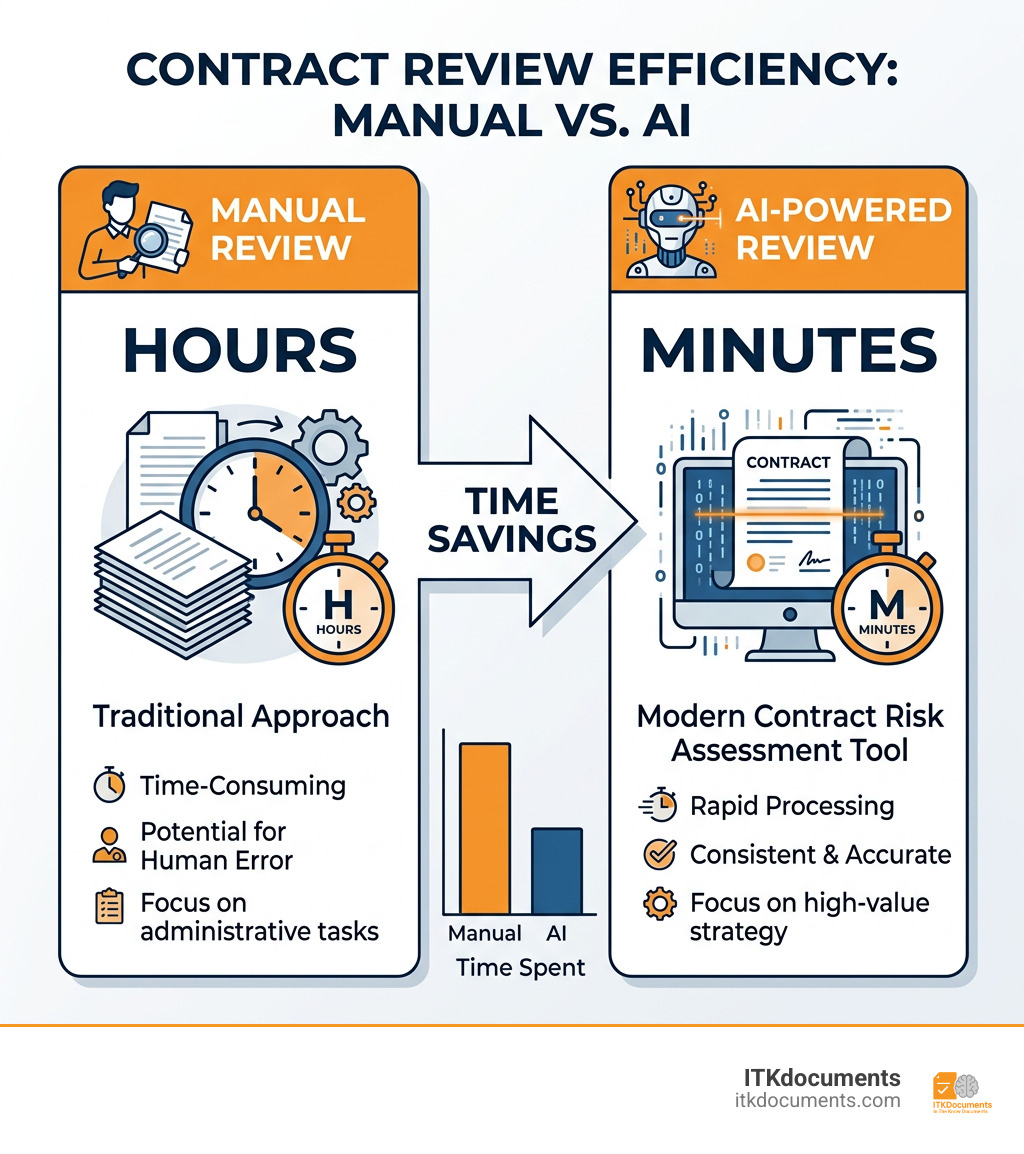
The "old way" of doing things is becoming unsustainable. Research shows that workload is expected to rise for legal teams over the next three years, yet manual review already eats up about 50% of a legal professional’s week. Human error is inevitable when you're tired, and a single missed sentence in a 50-page Master Service Agreement can cost millions in unforeseen damages.
This is where AI changes the game. While a manual review might take hours or days, an AI-powered contract risk assessment tool can complete a full review in just 2-3 minutes. Some platforms report up to 60% time savings, allowing legal teams to focus on high-value strategy and complex negotiations rather than administrative drudgery. This efficiency doesn't just save time; it accelerates the entire sales and procurement cycle.
These tools use Natural Language Processing (NLP) to perform "semantic" analysis. They don't just look for the word "risk"; they understand that a clause about "unforeseen environmental delays" is a risk even if the word 'danger' or 'hazard' is never used. By using features to Extract Obligations, these tools ensure that once a contract is signed, the promises made aren't forgotten. This real-time flagging and standardization ensure that every contract across your organization meets the same high bar for safety, regardless of which department initiated the deal.
Best Practices for Software Implementation
Buying the software is only half the battle; implementing it correctly is where the value is truly unlocked. We recommend starting with stakeholder alignment. Ensure that procurement, legal, and finance are all on the same page regarding what constitutes an "acceptable" risk. Without this alignment, the tool will flag issues that your team might actually be willing to accept, leading to unnecessary bottlenecks.
| Feature | Manual Assessment | Automated AI Assessment |
|---|---|---|
| Speed | Hours to Days | 2-3 Minutes |
| Consistency | Subjective / Variable | Standardized / Objective |
| Error Rate | High (Human Fatigue) | Low (Algorithmic Precision) |
| Cost | High (Billable Hours) | Low (Scalable Software) |
| Bulk Analysis | Nearly Impossible | Instantaneous |
Integration is another key pillar. Your contract risk assessment tool shouldn't live on an island. It should connect with your existing CLM (Contract Lifecycle Management) software or cloud storage solutions like Google Drive, Dropbox, or SharePoint. This connectivity ensures that documents flow seamlessly from creation to assessment without manual uploading. For example, at ITKDocuments, we prioritize a "5-minute setup to value" because we know you don't have months to spend on a complex rollout. Our goal is to provide immediate utility, allowing you to upload your first batch of contracts and see risk scores within minutes of signing up.
Once live, use an SLA Dashboard to monitor performance. Continuous auditing is essential—don't just assess the risk at the signature stage. Monitor the contract throughout its life to ensure obligations are being met and that the risk profile hasn't shifted due to new regulations. Workflow automation can then trigger alerts for expiring clauses or missed milestones, creating a truly integrated software ecosystem that protects the company 24/7.
Frequently Asked Questions about Contract Risk Assessment
What are the main types of risks found in contracts?
As we've touched on, the "Big Four" are financial, legal, compliance, and operational. Financial risks include hidden fees, poor payment terms, or lack of price protection. Legal risks involve lopsided indemnity, intellectual property theft, or unfavorable termination rights. Compliance risks are failures to follow laws like HIPAA, GDPR, or industry-specific mandates. Operational risks are the "how" of the contract—what happens if the vendor doesn't show up, if there are supply chain disruptions, or if a "force majeure" event occurs? Understanding these categories helps teams prioritize which clauses to scrutinize most heavily.
Can a contract risk assessment tool replace legal advice?
Absolutely not. While these tools are incredibly powerful, they are not a substitute for a qualified attorney. Think of the tool as a high-powered metal detector. It can find the "landmines" (risks) in a field of text very quickly, but you still need a human expert to decide the best way to disarm them or negotiate a workaround. The tool flags the risk and provides the data; the lawyer provides the strategic counsel and final decision-making. This partnership between human and machine—often called 'augmented intelligence'—is what creates the most robust risk management strategy.
How does a contract risk assessment tool handle bulk analysis?
This is one of the greatest strengths of AI. If you have 1,000 legacy contracts and need to know which ones have a specific liability cap or a change-of-control provision, a human would take months to find out. An AI tool can perform bulk analysis by scanning the entire set simultaneously. It generates combined reports that provide portfolio-wide oversight, allowing you to optimize resources, identify systemic risks across all your vendor relationships at once, and prepare for audits or acquisitions with unprecedented speed.
Conclusion
Choosing the right contract risk assessment tool is about more than just speed—it’s about gaining peace of mind. Whether you are looking for deep enterprise-grade risk analysis, rapid-fire automated reviews, or the user-friendly, obligation-focused approach we take here at ITKDocuments, the goal remains the same: protecting your business from the "unknown unknowns" that hide in the fine print.
The future of contracting is generative and intelligent. We are moving toward a world where contracts aren't just static PDFs, but living data points that proactively tell you when something is wrong. With a 5-minute setup and instant AI risk assessments, we invite you to see how much easier your workload can become when you have the right technology in your corner.
Ready to stop squinting at fine print and start managing your contracts with confidence? Visit our Home page to start your free trial and take the first step toward a risk-aware, efficient future for your legal and procurement teams.