 Mike O'Brien
What Is Contract Compliance Tracking (And Why It Matters)

What Is Contract Compliance Tracking (And Why It Matters)
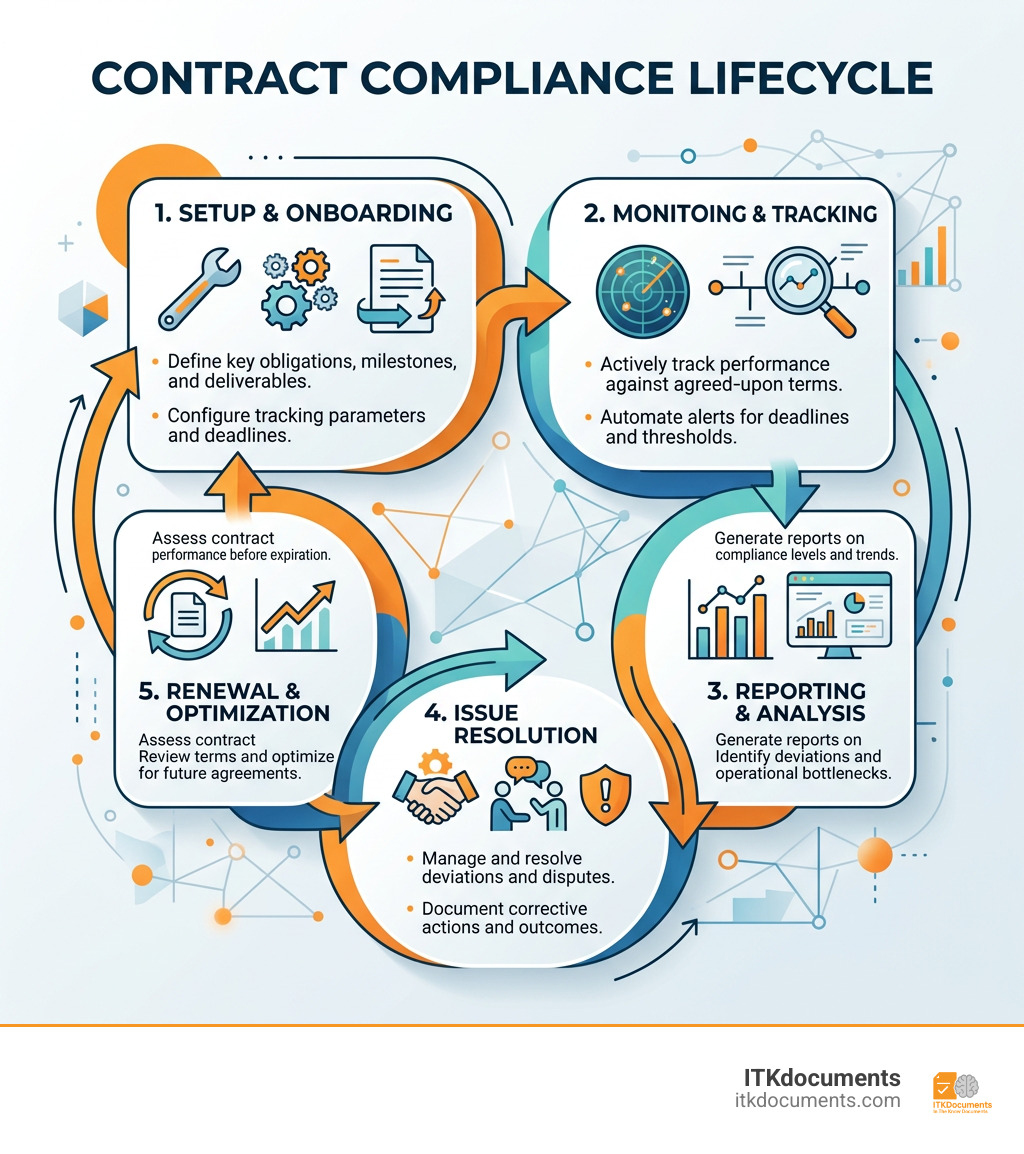
Contract compliance tracking is the ongoing process of monitoring whether all parties in an agreement are meeting their obligations — including deadlines, payments, service levels, and deliverables — throughout the full life of a contract.
Here's a quick summary of what it involves:
| What You Track | Why It Matters |
|---|---|
| Obligation deadlines | Prevents missed milestones and penalties |
| SLA performance | Ensures service quality is maintained |
| Payment terms | Protects revenue and avoids disputes |
| Regulatory requirements | Reduces legal and compliance risk |
| Renewal dates | Avoids unintended auto-renewals or lapses |
Imagine your organization signs dozens of contracts every month. Each one contains critical obligations buried in dense legal text. Without a system to track them, missed deadlines go unnoticed, payments stall, service levels slip, and compliance risks quietly multiply — often until it's too late.
This isn't a rare scenario. Ineffective contract management costs organizations up to 9% of their annual revenue. That's not a rounding error. For most businesses, it's a significant and largely preventable loss.
Yet many teams are still relying on spreadsheets, email reminders, and manual reviews to manage hundreds — sometimes thousands — of active contracts. At low volumes, that's manageable. At scale, it becomes a serious business risk.
This guide walks you through how to build a reliable, scalable contract compliance tracking process — from identifying obligations to reporting on performance.
I'm Mike O'Brien, founder and CEO of ITKDocuments and former Chief Procurement Officer at Aviva, where I managed multibillion-dollar contract portfolios and saw how poor contract compliance tracking translates directly into value leakage, missed risk signals, and strained supplier relationships. That experience is the foundation of everything covered in this guide.
The Strategic Importance of Contract Compliance Tracking

When we talk about contract compliance tracking, we aren't just talking about checking boxes to keep the legal department happy. We are talking about the "immune system" of your business relationships.
The stakes are high. Research shows that organizations implementing CLM software experience an 80% reduced risk rate in contract compliance. Without these systems, value leakage occurs silently.
Effective tracking ensures that the Terms and conditions you spent weeks negotiating actually manifest in the real world.
Defining Compliance as a Two-Way Street
It's easy to think of compliance as something you "enforce" on a vendor. In reality, it's a two-way street. To be compliant, you must be aware of what the counterparty expects from you just as much as what you expect from them.
This mutual awareness requires constant performance monitoring. If your Service definition document stipulates that you must provide data access within 24 hours for a project to stay on track, and you fail to do so, you are the non-compliant party.
The Impact of Non-Compliance on Revenue and Risk
The financial consequences of "flying blind" are staggering. According to IBM's 2024 Cost of a Data Breach Report, the global average cost of a data breach reached USD 4.88 million.
Non-compliance also leads to:
- Legal Penalties: Fines from regulators for failing to meet statutory obligations.
- Reputational Damage: Losing the "partner of choice" status in your industry.
- Missed Savings: Failing to trigger "most favored nation" clauses or inflation-based price adjustments.
Navigating Challenges in Modern Compliance Management
Why is contract compliance tracking so hard? For most companies, the data is fragmented.
Overcoming Data Silos and Visibility Gaps
The first hurdle is the lack of a centralized repository. To solve this, you need to Extract Metadata from every agreement to create a "single source of truth."
Managing Regulatory Complexity Across Industries
- Healthcare: Must track HIPAA compliance and Business Associate Agreements.
- Finance: Focuses on Basel III, AML, and cybersecurity SLAs.
- Tech/Data: Must navigate the California Consumer Privacy Act and GDPR.
- Government Contracting: Requires strict adherence to FAR standards.
Best Practices for Effective Contract Compliance Tracking
| Feature | Manual (Spreadsheets) | Automated (AI-Powered) |
|---|---|---|
| Speed | Slow, prone to human error | Instant extraction and analysis |
| Alerts | Relies on manual calendar entries | Automatic notifications for milestones |
| Visibility | Siloed in individual files | Centralized dashboard for all stakeholders |
| Audit Trail | Often incomplete or missing | Immutable logs of every action |
Key Best Practices for Contract Compliance Tracking
- Create a Centralized Playbook: Define your standard "fallback" clauses and approval workflows.
- Use Standardized Templates: Reduce variability by using pre-approved language.
- Set Milestone Alerts: Track the 90-day window for renewals and the 30-day window for SLA reviews.
- Implement Proactive Remediation: Flag KPI dips before they become breaches.
- Utilize Reporting: Use Reporting tools for executives and managers.
Establishing Roles and Accountability
- Legal: Owns the language and regulatory alignment.
- Procurement/Sales: Owns the commercial relationship.
- Finance/Revenue Operations: Ensures revenue operations are optimized.
Technology and AI: The Future of Compliance Monitoring
How AI Transforms Contract Compliance Tracking
AI doesn't just read words; it understands intent. Through NLP, tools can Extract Obligations automatically.
At ITKdocuments, we use AI to Extract SLA details and set up an SLA Dashboard instantly.
Benefits of Customizable Dashboards and Reporting
Executives want a Dashboard that shows:
- Total contract value at risk.
- Upcoming renewals in the next 60 days.
- Top 5 non-compliant vendors.
Measuring Performance and Conducting Compliance Audits
The Step-by-Step Contract Compliance Audit Process
- Document Collection: Gather all relevant agreements and amendments.
- Stakeholder Interviews: Talk to the people managing the day-to-day relationship.
- Compliance Testing: Compare actual performance data against obligations.
- Remediation Plans: Fix gaps through re-negotiation or process changes.
- Review Services: Check if Services still align with strategy.
Calculating the ROI of Compliance Initiatives
- Efficiency Gains: Hours saved by using AI for extraction.
- Risk Mitigation: Avoided cost of potential fines or breaches.
- Cost Savings: Recovered revenue from catching unbilled fees or missed discounts.
Frequently Asked Questions about Contract Compliance Tracking
Who is responsible for contract compliance in an organization?
It depends on the company's size. In large enterprises, there is often a dedicated Compliance Officer or Contract Manager. In smaller companies, it is usually shared between Legal, Finance, and business unit leads.
How often should contract compliance audits be conducted?
For high-risk or high-value contracts, we recommend quarterly reviews. For standard contracts, an annual audit is usually sufficient. Major regulatory changes should trigger immediate audits of all affected contracts.
What are the most important KPIs for tracking contract performance?
- Obligation Fulfillment Rate: Percentage of contractual milestones met on time.
- Financial Accuracy: Variance between contracted pricing and actual invoiced amounts.
- Renewal Cycle Time: How long it takes to move from a renewal notice to a signed extension.
Conclusion
Contract compliance tracking has evolved from a manual burden into a core strategic priority.
At ITKdocuments, we've built our platform to eliminate the "drudgery" of compliance. With our AI-powered extraction and instant risk assessments, you can move from a signed document to full visibility in less than five minutes.
Ready to see your contracts in a whole new light? More info about our Dashboard is just a click away.