 Mike O'Brien
Contract Compliance Software: The Complete Guide to Post-Signature Enforcement

The Contracts Are Signed — Now the Real Work Begins
Contract compliance software is the category of tools that helps organizations track, enforce, and report on the obligations inside their contracts — after the ink has dried.
Here's a quick look at the top options to help you evaluate:
| Software | Best For | Key Strength |
|---|---|---|
| ITKDocuments | CLM with Obligation & SLA tracking | AI document intelligence |
| B2Gnow | Government/diversity programs | DBE/MBE/WBE multi-tier tracking |
| Agiloft | Enterprise CLM | No-code automation, 80% less untracked spend |
| Icertis | Fortune 500 enterprises | AI trained on 17M+ contracts |
| Ironclad | Legal & sales teams | Gartner-recognized AI CLM |
| ContractSafe | SMBs & mid-market | Simple setup, volume-based pricing |
| ContractZen | SMBs & governance | Unified GRC platform |
Most contract tools focus on getting deals signed. Compliance software focuses on what happens after — making sure both sides actually do what they agreed to.
And right now, most teams are failing at that. Nearly half of lawyers still store contracts in Google Drive. Four in ten businesses have no clearly assigned roles for contract management. And 38% of in-house lawyers have burned out in the past year — partly because manual compliance tracking is relentless, error-prone work.
If your team is chasing down subcontractor payments in spreadsheets, missing SLA deadlines, or scrambling before an audit, you're not alone. This guide is for you.
I'm Mike O'Brien, founder of ITKDocuments and former Chief Procurement Officer at Aviva, where I managed multibillion-dollar contract portfolios and saw how much value leaks when organizations can't extract actionable insight from their contract compliance software and documents. That experience is the foundation for everything we've built — and for this guide.
What is Contract Compliance Software and Why Does It Matter?
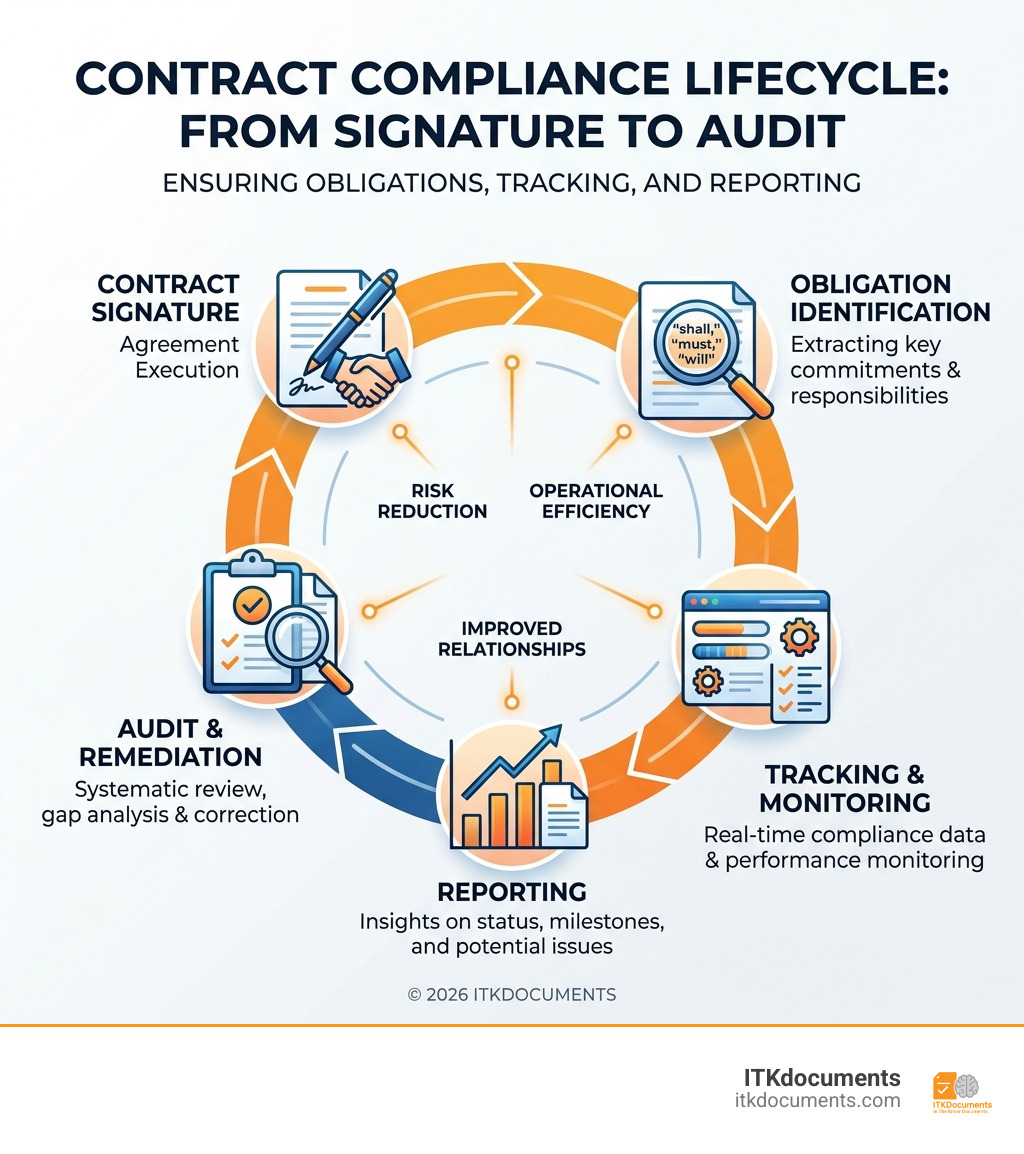
At its core, contract compliance software is the digital watchdog of your business agreements. While standard management tools might just store a PDF, compliance-focused software digs into the text to ensure that every "shall," "must," and "will" is actually being followed.
The primary mission of this software is obligation management. This means identifying exactly what each party is responsible for—whether it's a delivery date, a specific quality standard, or a recurring payment—and tracking it through to completion. Without this, organizations often fall victim to hidden contract risks that live in the fine print, such as auto-renewals for services no longer in use or missed rebates.
Post-signature enforcement is where the ROI truly lives. It's one thing to negotiate a great deal; it's another to ensure the vendor actually delivers the promised 99.9% uptime. By using AI to extract obligations, businesses can move away from "hope-based" management to data-driven enforcement. This is especially critical for meeting regulatory standards in industries like healthcare or finance, where a single missed compliance check can lead to massive fines.
How it Differs from General Contract Management
It is a common mistake to think that a digital filing cabinet (like Google Drive or a basic CLM) is the same as a compliance tool.
- General Contract Management (CLM): Focuses on the "Contract Lifecycle"—templates, drafting, redlining, and getting the e-signature. It's about the journey to the signature.
- Contract Compliance Software: Focuses on the "Performance Tracking" phase. It's about the journey after the signature.
Compliance software provides audit readiness by maintaining a golden record of every action taken. It doesn't just show you the contract; it shows you the proof of performance. For example, instead of just storing a Service Level Agreement (SLA), specialized software can extract SLA terms and link them to real-time performance data, alerting you the second a vendor dips below their promised metrics.
The High Cost of Manual Compliance
Relying on human memory and spreadsheets for compliance is a recipe for financial leakage. Research shows that businesses lose an average of $122 for every hour in-house counsel spends manually digging through contracts. Even worse, poor contract management can lead to a staggering 9% revenue leakage annually due to missed milestones and uncollected penalties.
The human cost is just as high. With 40% of businesses lacking clearly assigned roles for contract oversight, the work often falls on overwhelmed legal or procurement teams, leading to the high burnout rates we see today. When roles are ambiguous, things get missed, and "untracked spending" begins to balloon.
Key Features of Effective Contract Compliance Software
When you are evaluating a contract compliance software solution, you aren't just looking for a place to store files. You are looking for an engine that generates actionable intelligence.

One of the most transformative features is AI-powered metadata extraction. This technology scans your documents and automatically identifies key fields like parties, effective dates, and termination notice periods. This allows you to extract metadata without manual data entry, which is the number one cause of errors in contract databases.
Other essential features include:
- Automated Alerts: Notifications sent to stakeholders before a deadline hits, not after.
- Payment Verification: Ensuring that invoices match the contracted rates and that subcontractors have been paid before the prime contractor receives their next installment.
- SLA Dashboards: A visual way to track SLAs across dozens of vendors simultaneously.
- Deep Reporting: The ability to generate compliance reporting for auditors or board members with a single click.
Manual Tracking vs. Automated Compliance Software
| Feature | Manual (Spreadsheets/Email) | Automated Compliance Software |
|---|---|---|
| Data Entry | Manual, high error rate | AI-extracted, 99% accuracy |
| Searchability | "Ctrl+F" in individual files | Global Search across all docs |
| Deadline Tracking | Calendar reminders (often missed) | Automated multi-tier alerts |
| Reporting | Days of manual compilation | Instant, real-time dashboards |
| Audit Trail | Fragmented email chains | Centralized, immutable logs |
Ensuring Regulatory and Diversity Compliance
For organizations working with government entities or in highly regulated sectors, compliance isn't just about efficiency—it's about staying in business. Contract compliance software is vital for tracking DBE/MBE/WBE/SBE (Disadvantaged, Minority, Women, and Small Business Enterprise) participation.
In government contracting, you are often required to prove that a certain percentage of your spend is going to diverse vendors. Software like B2Gnow specializes in this, offering multi-tier reporting that tracks payments down to the tenth tier of subcontractors. This ensures that "Prime" contractors aren't just promising diversity but are actually delivering it.
Furthermore, these tools help manage the Davis-Bacon Act and prevailing wage requirements. By digitizing the verification of certified payrolls, the software prevents the risk of federal funding loss or contract termination.
AI-Driven Risk Mitigation
The "secret sauce" of modern contract compliance software is its ability to flag risks before they become disasters. AI can scan thousands of pages to find non-standard clauses or missing indemnifications.
The impact of this is measurable. For example, organizations using advanced CLM tools like Agiloft have reported an 80% reduction in untracked spending and a 70% reduction in compliance administration time. By using AI to search for specific risk triggers across your entire portfolio, you turn your legal department from a "cost center" into a "risk-mitigation powerhouse."
Choosing the Right Solution for Your Industry
Not all compliance tools are built the same. The "right" choice depends heavily on your specific regulatory environment.
- Government & Construction: Look for tools that emphasize subcontractor payment tracking, certified payroll, and diversity goal monitoring.
- Healthcare: Security is paramount. Ensure the software offers SOC-2 Type II compliance, MFA (Multi-Factor Authentication), and HIPAA-compliant data handling.
- General Enterprise: Focus on services that offer deep integrations with your existing tech stack (like Salesforce or Microsoft 365) and strong AI for obligation extraction.
When vetting a provider, ask about their implementation satisfaction rates. Some legacy systems can take months (or years) to set up, while modern, cloud-native solutions can provide value in days.
Implementation and ROI Expectations
The financial argument for contract compliance software is incredibly strong. On average, organizations see a 356% ROI over three years. This comes from several areas:
- Cycle Time Reduction: Closing deals and verifying compliance 50% faster.
- Administrative Savings: Cutting the time spent on manual audits and data entry.
- Revenue Protection: Ensuring you never miss a price increase or a penalty you are owed.
To achieve these numbers, user adoption is key. If the software is too complex, your team will go back to using spreadsheets. Look for a solution with a clean, intuitive dashboard that makes it easy for non-lawyers to see what needs to be done.
Frequently Asked Questions about Compliance Tools
What is the difference between CLM and contract compliance software?
While Contract Lifecycle Management (CLM) covers the entire journey from request to renewal, compliance software is a specialized subset of CLM. CLM often focuses on the "pre-signature" workflow (drafting and signing), whereas compliance software is laser-focused on the "post-signature" phase (tracking obligations, payments, and regulatory adherence).
How does AI handle multi-tier subcontractor reporting?
AI-driven compliance tools use "vendor portals" where subcontractors at every level (Tier 1, Tier 2, etc.) log their own payment data. The AI then cross-references this data against the Prime contractor's reports. If there is a discrepancy—such as a Prime claiming they paid a sub, but the sub reporting they haven't received funds—the system automatically flags the conflict for review.
What are the common pricing models for compliance platforms?
There are three main models:
- User-Based: You pay per seat. This can get expensive if you want the whole company to have visibility.
- Volume-Based: You pay based on the number of contracts stored (e.g., ContractSafe). This is often better for encouraging company-wide adoption.
- Tiered Enterprise: A flat annual fee based on the features and level of support required.
Conclusion
The days of "signing and forgetting" contracts are over. In an era of tightening regulations and shrinking margins, your agreements must be treated as living data, not static paper.
At ITKDocuments, we believe that compliance shouldn't be a chore. We've designed our platform to offer a 5-minute setup to value, allowing you to instantly perform AI risk assessments and extract critical obligations from your existing documents. Whether you need to track SLAs, flag hidden contract risks, or simply get a better handle on your reporting, we are here to help you stop chasing paper and start driving value.
Ready to see how AI can transform your compliance workflow? Explore our blog for more insights or start your journey at https://itkdocuments.com/.