 Mike O'Brien
Why Legal AI Document Analysis Is Changing How Lawyers Work

Why Legal AI Document Analysis Is Changing How Lawyers Work
Legal AI document analysis is the use of artificial intelligence to automatically read, extract, and interpret information from legal documents — replacing hours of manual review with results in minutes.
Here's what it does at a glance:
| What AI Does | What That Means for You |
|---|---|
| Reads and summarizes documents | No more skimming 500-page contracts |
| Flags risks and unusual clauses | Catch problems before they become costly |
| Extracts key obligations and dates | Never miss a deadline or SLA again |
| Identifies parties, terms, and metadata | Instant structured data from raw documents |
| Processes scanned and multilingual files | Works on virtually any document format |
Legal document review has always been slow, expensive, and prone to human error. A single contract negotiation can involve dozens of documents. A large discovery process can involve millions. Even experienced attorneys miss things — especially under time pressure.
The volume isn't getting smaller. And the cost of missing a critical clause, obligation, or risk is only getting higher.
AI tools now process thousands of pages in minutes, with some platforms analyzing 1,000+ page documents in under two minutes. That's not a small improvement — it's a fundamentally different way of working.
For contract managers and compliance officers, this matters most where it hurts most: missed obligations, overlooked SLA triggers, and value leakage buried deep in document language.
I'm Mike O'Brien, founder and CEO of ITKDocuments and former Chief Procurement Officer at Aviva, where I personally managed multibillion-dollar contract portfolios and saw how organizations lose value by failing to extract actionable insight from their documents. That experience is what drives my work in legal AI document analysis and the practical tools built to solve it.
How Legal AI Document Analysis Works
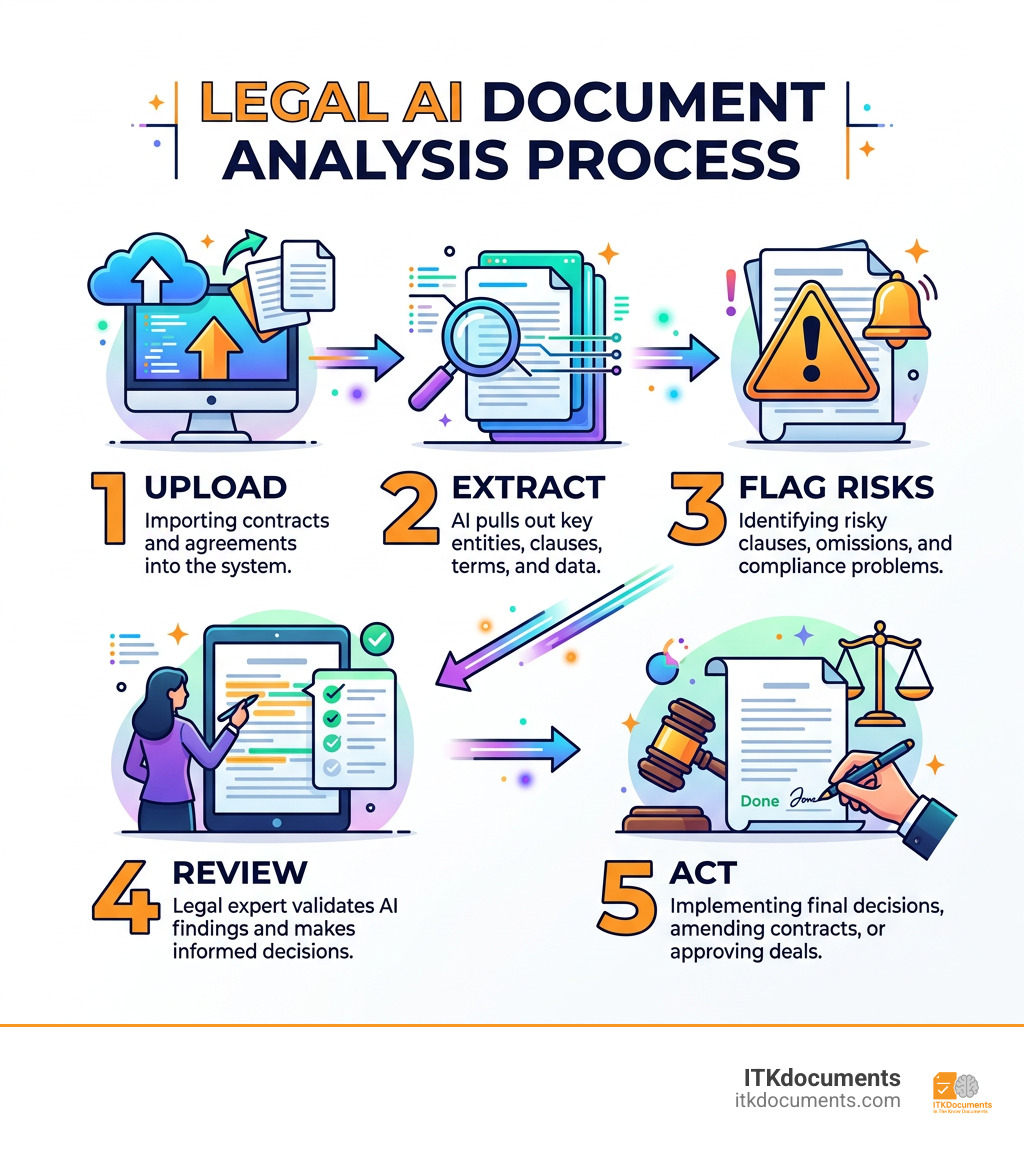
To the uninitiated, legal AI document analysis might look like magic. You drop a 100-page PDF into a browser window, and two minutes later, you have a list of every termination clause, indemnity risk, and governing law. But beneath the surface, several sophisticated technologies are working in harmony to "read" the text much like a human would—only significantly faster.
The process typically begins with Natural language processing, which allows the computer to understand the nuances of human language. Unlike a simple keyword search that looks for the word "Termination," NLP understands the context. It knows the difference between a "Termination for Convenience" and a "Termination for Cause."
To make this data useful, we use Machine learning to identify patterns and connections between documents. For example, if you are reviewing 500 NDAs, machine learning can group them by how aggressive their non-solicit clauses are.
Before any of that can happen, however, the system needs to be able to see the text. Many legal documents are still stuck in "dead" formats like scanned images or faxes. Optical character recognition (OCR) converts these images into searchable, machine-readable text. Once the text is "alive," we can Extract Metadata such as execution dates, party names, and contract values, turning a messy document into a structured database.
Core Technologies Behind Legal AI Document Analysis
The latest generation of legal AI document analysis tools utilizes Retrieval-Augmented Generation (RAG). This is a fancy way of saying the AI doesn't just guess based on what it learned during training; it actually looks at your specific document as its primary source of truth. This significantly reduces "hallucinations" (when AI makes things up) and ensures that every insight is grounded in the actual text of your file.
Semantic search is another game-changer. Instead of searching for the exact phrase "limitation of liability," you can ask the AI, "How much can we be sued for under this deal?" The AI understands the meaning of your question and finds the relevant section, even if the wording is different. For those interested in the technical specifics of how these systems handle data, checking out detailed Docs on platform architecture can provide peace of mind regarding accuracy and logic.
Handling Complex Document Challenges
Legal documents are rarely clean. They are full of nested tables, multi-column layouts, and sometimes even handwritten notes. Modern AI is built to handle these "noisy" inputs.
- Tables and Figures: Dense M&A agreements often hide critical financial obligations in exhibits and schedules. Advanced AI uses vision-language models to interpret these tables correctly, ensuring that a number in a cell is linked to the correct header.
- Multilingual Content: In our global economy, a single deal might involve documents in English, German, and Mandarin. AI can translate and analyze these simultaneously, identifying risks across different jurisdictions.
- SLA Tracking: One of the biggest headaches for procurement teams is managing Service Level Agreements. AI can Extract SLA terms from deep within a document's attachments, identifying exactly what performance metrics were promised and what the penalties are for missing them.
Key Benefits of AI in Legal Document Review
The primary reason law firms and legal departments are flocking to AI is simple: manual review is a bottleneck that costs too much and moves too slowly.
Research shows that AI for legal document review can lead to 60% faster review times. In some cases, it's even more dramatic—automated systems can process 1,000 pages in under two minutes, which is roughly 100x faster than a senior attorney could read them. For a firm, this translates into a 50% reduction in costs and the ability to reclaim over 3 billable hours per day.
Beyond speed, there is the benefit of consistency. Humans get tired; AI doesn't. Whether it's the first document of the day or the ten-thousandth, the AI applies the same rigorous logic. To keep track of these gains, we often use Reporting features to show exactly how much data has been processed and where the time savings are coming from.
Improving Efficiency in eDiscovery and Case Prep
In litigation, eDiscovery is often the most expensive phase of a case. Legal AI document analysis streamlines this by:
- Building Narratives: AI can extract facts, dates, and names from thousands of emails and filings to create a chronological timeline of events.
- Entity Extraction: Automatically identifying every person, company, and location mentioned in a case file.
- Automated Translation: Quickly translating foreign language discovery documents to determine if they are relevant before paying for expensive certified translations.
To stay on top of these massive projects, tools like an SLA Dashboard allow project managers to see the status of document processing in real-time, ensuring that court deadlines are never missed.
Enhancing Risk Detection and Clause Extraction
For transactional lawyers, the "holy grail" is finding the needle in the haystack—that one clause that could ruin a deal. AI excels at Hidden Contract Risks detection. It can flag "Change of Control" provisions that might be triggered during an acquisition or identify unusually broad indemnity clauses that deviate from your firm's "gold standard."
By using AI to Extract Obligations, firms can move from a reactive state (finding out about a problem when it happens) to a proactive state (knowing every commitment the firm has made across its entire portfolio).
Essential Features of Legal AI Document Analysis Software
Not all AI is created equal. When evaluating software, you should look for tools that offer more than just a "chat" interface.
| Feature | Manual Review | AI-Powered Analysis |
|---|---|---|
| Speed | 5-10 pages per hour | 500+ pages per minute |
| Accuracy | Prone to fatigue/oversight | 94%+ on benchmarks |
| Cost | High (hourly rates) | Low (subscription/per-doc) |
| Scalability | Limited by headcount | Virtually unlimited |
| Search | Keyword-based | Semantic/Contextual |
High-quality software uses "intelligent chunking," which breaks down long documents into logical sections while maintaining the context of the whole. It should also provide a "confidence score" for its findings, telling you how certain it is that it found a specific clause. Batch processing is another must-have, allowing you to Extract Metadata from hundreds of files simultaneously rather than one by one.
Security Protocols for Legal AI Document Analysis
Security is the biggest concern for any legal professional. You are dealing with highly sensitive, privileged information. Any tool you use must meet "bank-grade" security standards. This includes SOC 2 Type II, ISO 27001, and GDPR compliance.
Furthermore, you must consider the ethical considerations of AI. Does the tool use your data to train its public models? (The answer should be a firm "No"). Look for "Zero-Data Retention" policies where your documents are processed and then either deleted or stored in an encrypted "vault" that only you can access.
Integration and Workflow Automation
AI shouldn't be another "silo" of information. It needs to live where your work lives. The best tools offer:
- Cloud Storage Sync: Automatically pulling documents from SharePoint, Google Drive, or Box.
- API Access: Allowing your IT team to build custom connections between the AI and your existing practice management software.
- Workflow Agents: Custom AI "bots" that can be trained to perform specific tasks, like auditing all incoming vendor contracts against your company's specific compliance checklist.
For firms that don't have an in-house tech team, choosing a platform that offers professional Services to help with setup and customization is often the fastest path to ROI.
Best Practices for Implementing AI in Legal Workflows
You can't just buy a subscription and expect your firm to change overnight. Implementation requires a strategy.
First, establish a clear AI policy. This should outline what types of documents can be uploaded, who has access, and how the output must be verified. Human oversight is non-negotiable. AI is a powerful assistant, but the lawyer is the one who signs the brief and takes responsibility for the advice.
Second, consider data anonymization. Before uploading highly sensitive documents to a cloud-based AI, some firms choose to redact names or specific financial figures to add an extra layer of privacy. Finally, start small. Pick one use case—like using AI to Extract Obligations from a specific set of vendor contracts—and prove the value before rolling it out to the entire firm.
Evaluating Pricing Models and ROI
Most legal AI document analysis tools offer three types of pricing:
- Subscription Tiers: A flat monthly fee for a certain number of users or documents.
- Per-Document Fees: Common in eDiscovery, where you pay for what you process.
- Enterprise Custom: Tailored pricing for large firms with high volume needs.
When calculating ROI, don't just look at the software cost. Look at the "billable hour reclamation." If a solo practitioner can save 3 hours a day, that's 15 hours a week. At a $300 hourly rate, that's $4,500 in "found" time every week. You can track these gains through your SLA Dashboard to justify the investment to partners or stakeholders.
Frequently Asked Questions about Legal AI Document Analysis
Can AI completely replace human lawyers in document review?
No. While AI is 100x faster at the "grunt work" of finding and summarizing text, it lacks the professional judgment, empathy, and strategic thinking of a lawyer. AI is a "co-pilot." It identifies the issues, but the human lawyer decides how to use that information to win the case or close the deal.
What types of legal documents work best with AI tools?
AI is particularly effective with structured or semi-structured documents like:
- Contracts and NDAs: Great for clause extraction and risk flagging.
- M&A Due Diligence: Perfect for processing thousands of files in parallel.
- Pleadings and Discovery: Ideal for finding facts and building case timelines.
- Medical and Billing Records: Useful for personal injury lawyers creating chronologies.
How does AI handle privilege identification and sensitive data?
Modern AI uses "confidence scoring" to flag potentially privileged communications (like emails to/from outside counsel). It looks for specific patterns and names that indicate a document should be withheld from production. However, a human should always perform a final "privilege log" check.
Conclusion
The era of "reading every page" by hand is coming to an end. Legal AI document analysis is no longer a luxury for the biggest firms; it is a necessity for any legal professional who wants to remain competitive, accurate, and profitable.
At ITKdocuments, we've built our platform to solve the exact problems I faced as a CPO. We focus on getting you from "upload" to "insight" in under five minutes. Whether you need to automate your obligation extraction, perform a rapid risk assessment, or simply get your contract repository under control, we are here to help.
Ready to see what AI can do for your practice? Explore our full range of Services or Get started with obligation extraction today. Let us handle the documents so you can handle the law.